The Indian Agri-Stack
Or a simple guide to why Indian agriculture is a perfectly designed machine for setting money on fire.
The plough is the tool that made man free — and bound him.
Every so often, a video from Kolar, India, goes viral. A farmer stands, his face a mask of resignation, beside a mountain of perfectly good tomatoes. A bulldozer then drives over them, crushing the fruit into a worthless pulp. Your first thought is, “That seems inefficient.” And it is. But in the bizarro-world logic of Indian agriculture, it is a completely rational act. The price at the local market has fallen so low that the cost of transport is more than the sale price. So, you run them over with a bulldozer.
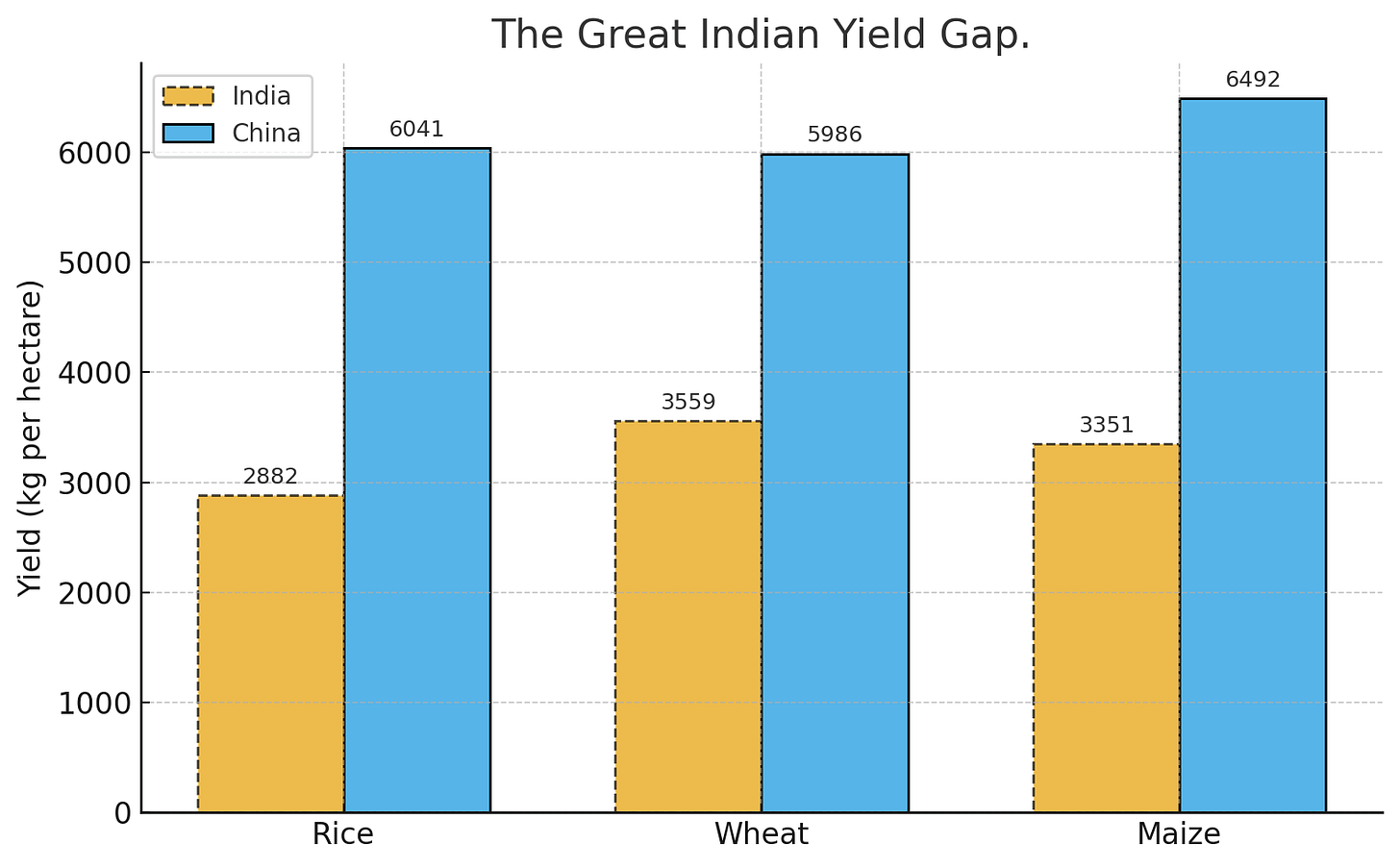
This is not a story about one farmer’s bad day. It is a story about a system. Indian agriculture is a behemoth. It is the world’s second-largest producer of farm output and employs nearly half the country. It is also, by almost any modern measure, a spectacular, continuously unfolding disaster. Farmer debt is endemic, yields are a fraction of global peers, and a staggering amount of food simply rots. This is not a system that is broken. It is a system that is cruel.
It is an “everything problem,” an interconnected machine where every terrible policy is a solution to another terrible policy. To understand it, we must first understand how it was built, and for whom. We will deconstruct the value chain into three distinct stacks.
-
The Pre-Farm Stack: The fuel of subsidies and debt.
-
The On-Farm Stack: The engine of perverse incentives.
-
The Post-Farm Stack: The exhaust of waste and extraction.
Let’s begin.
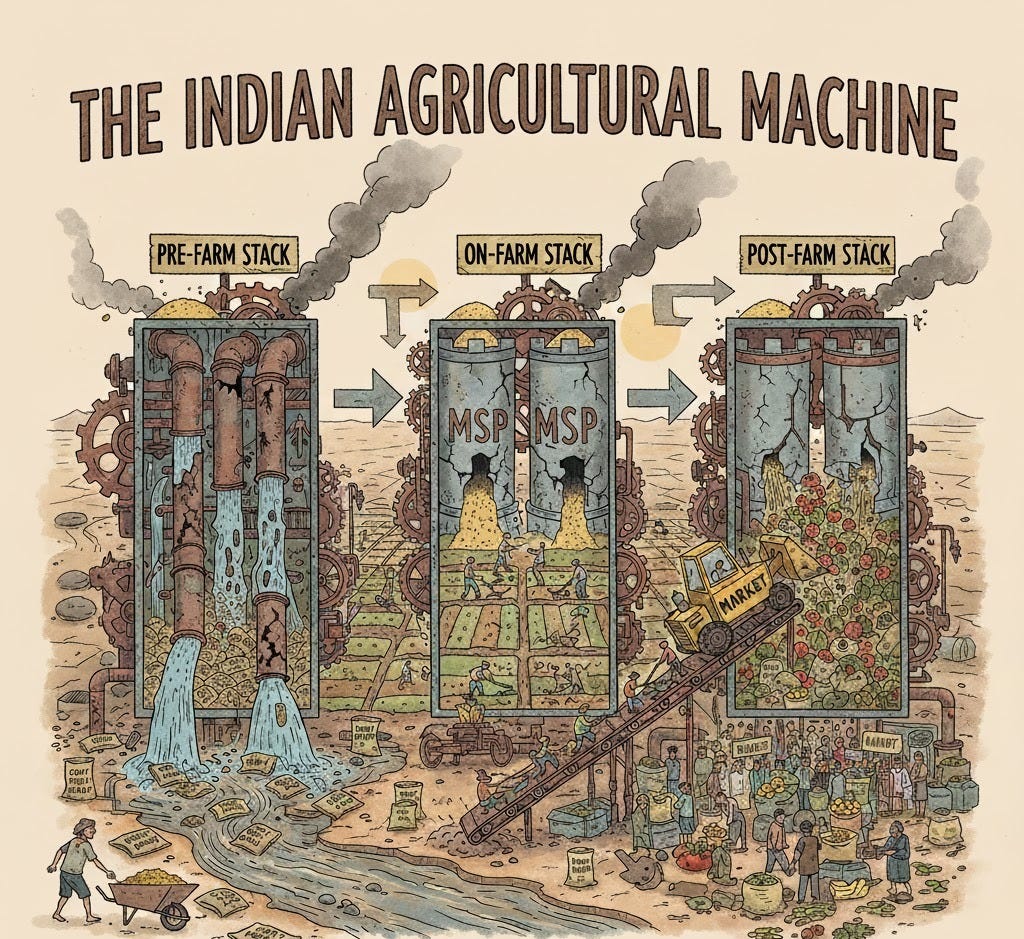
Part 1: The Pre-Farm Stack: The Fuel System
The machine’s logic begins long before a seed touches soil. The entire input ecosystem is a glorious Rube Goldberg¹ machine of subsidies designed to help farmers, which mostly helps them go broke in new and interesting ways.
The Input Subsidy Rube Goldberg Machine
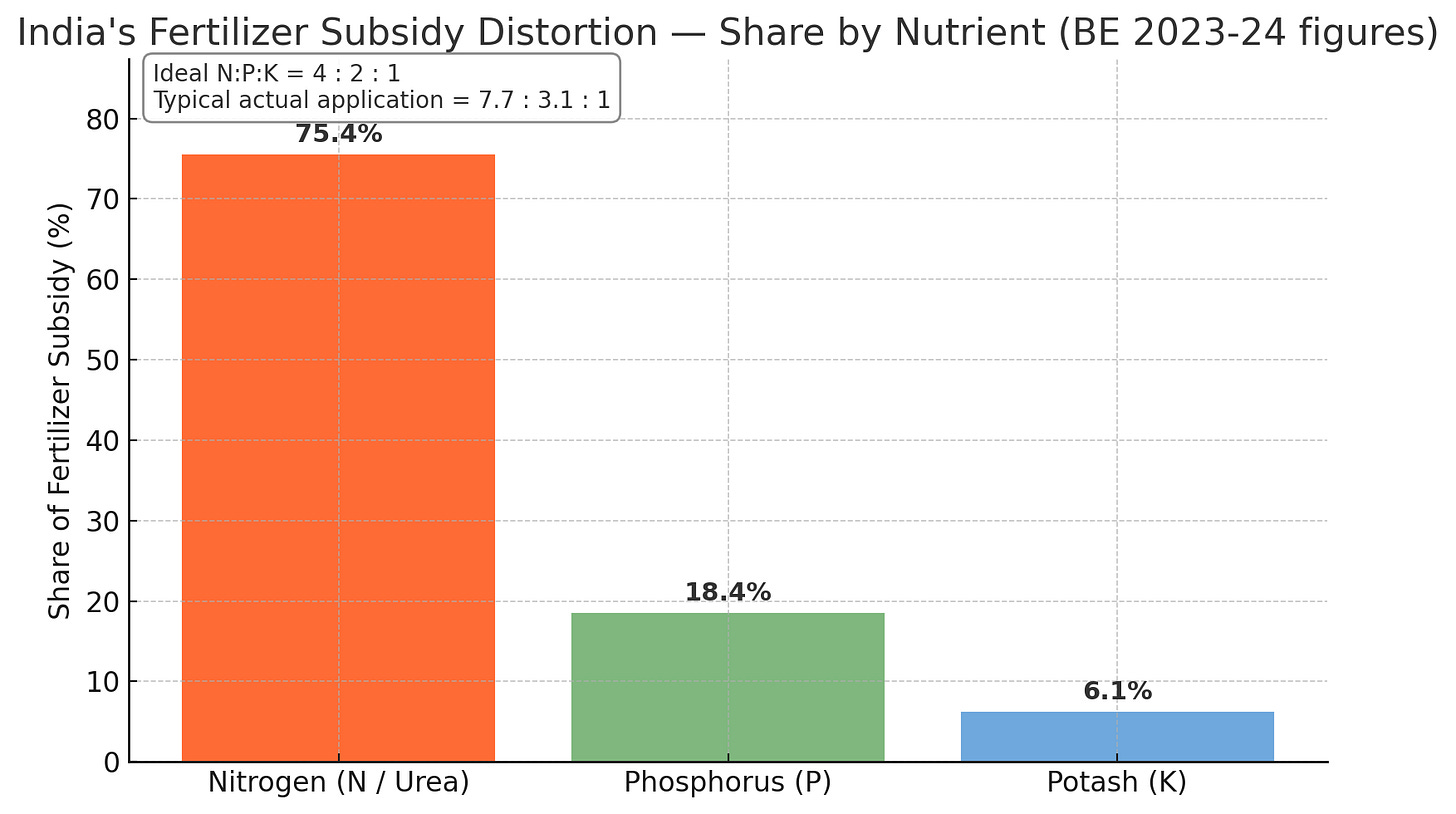
The main event is fertilizer. The government heavily subsidizes it, but in a lopsided way. Urea (N) is kept artificially cheap by price caps. Phosphatic (P) and Potassic (K) fertilizers are sold closer to market rates.
You are a rational actor in an irrational system. You see that one essential input is on a massive, government-sponsored sale. What do you do? You buy a ton of the cheap one. The ideal NPK ratio for Indian soil is about 4:2:1. The actual application ratio is something like 7.7:3.1:1. You are slowly poisoning your own land, becoming ever more dependent on the very chemicals that are the problem.
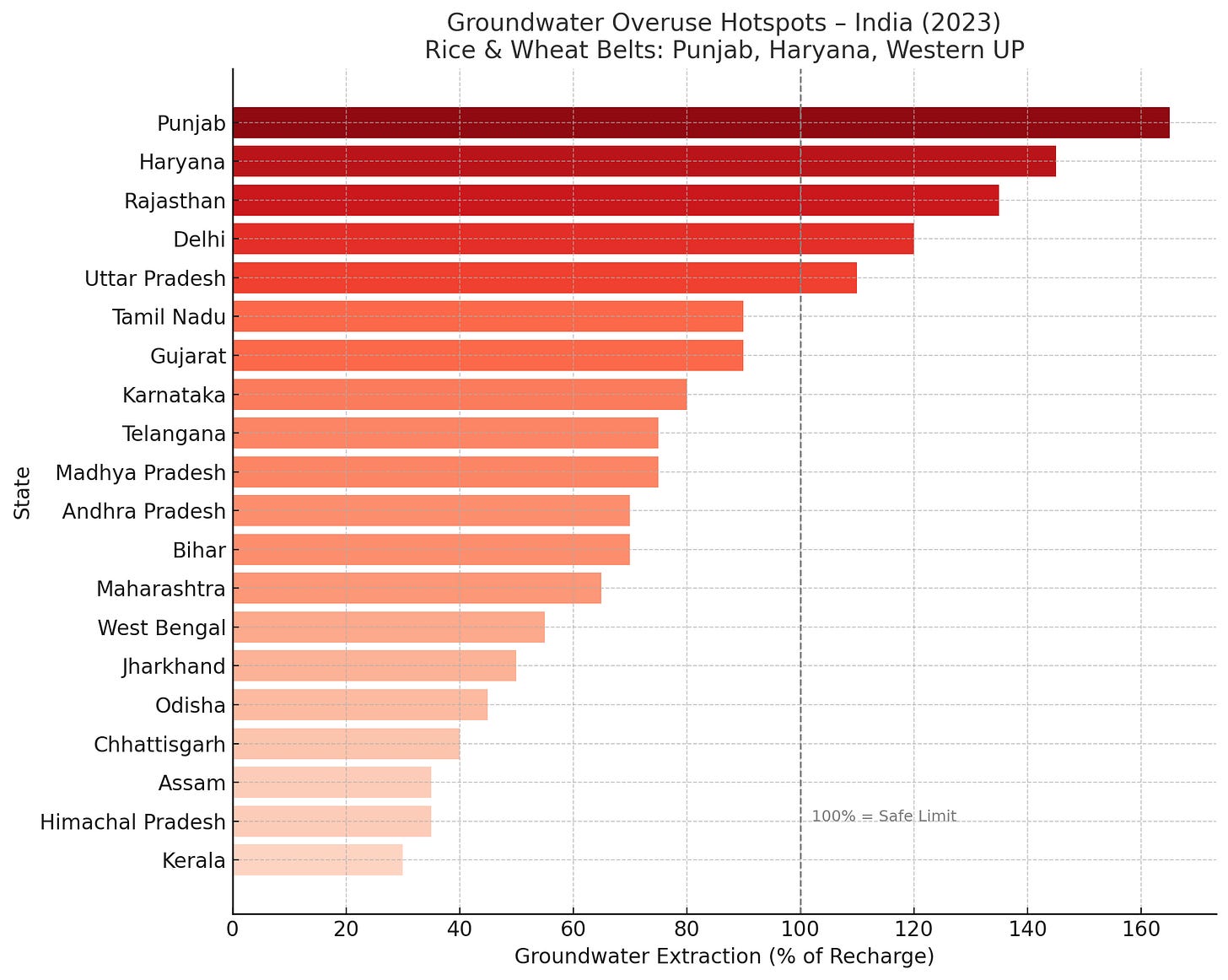
This pattern is mirrored in water and power. In many states, electricity for farms is free. So, you run your water pump 24/7, growing thirsty crops like rice in arid regions, accelerating a nationwide groundwater crisis. The subsidy for cheap power is a subsidy for depleting the country’s future.
India spends something like $48 billion a year on these recurring subsidies. For comparison, a fund to build long-term infrastructure has a total corpus of about $12 billion—total, not annual. We are spending all our money on cheap gasoline for a broken car, instead of fixing the car.
The Credit Conundrum
If subsidies distort physical inputs, the credit system distorts financial ones. Over half of farm households are in debt. The formal bank loan is for “productive purposes,” like seeds. But life happens. For a wedding or a medical bill, you go to the local moneylender, who will happily give you a loan at 50% interest. You get trapped in a two-tier debt spiral.
Then comes the farm loan waiver, a political tradition where, before an election, a government simply forgives all formal bank loans. It’s popular, and it’s a terrible idea. It wrecks the credit culture and, crucially, does nothing for the poorest farmers, whose debts are to the moneylenders.
Prescription (and its Discontents):
-
Just Give Them the Cash: Direct income support would be cleaner. The problem: This would dismantle a patronage system worth billions to the fertilizer and power industries, who have a rather strong say in policy.
-
Stop Waiving Loans: It’s a cynical tool that wins elections. The problem: In a system of desperate people, a promise of immediate relief will always be more potent than a lecture on long-term fiscal health.
-
Rationalize Input Prices via DBT: Use the Direct Benefit Transfer system that worked for cooking gas to send fertilizer subsidies directly to farmers, letting prices reflect reality. The problem: This is rational, proven, and therefore a direct threat to the opaque network of manufacturers and distributors who profit from the current mess.
Part 2: The On-Farm Stack: The Engine Block
With the inputs a mess, the farm itself becomes a machine for producing certainty, even at the cost of prosperity.
The Tyranny of Two Grains
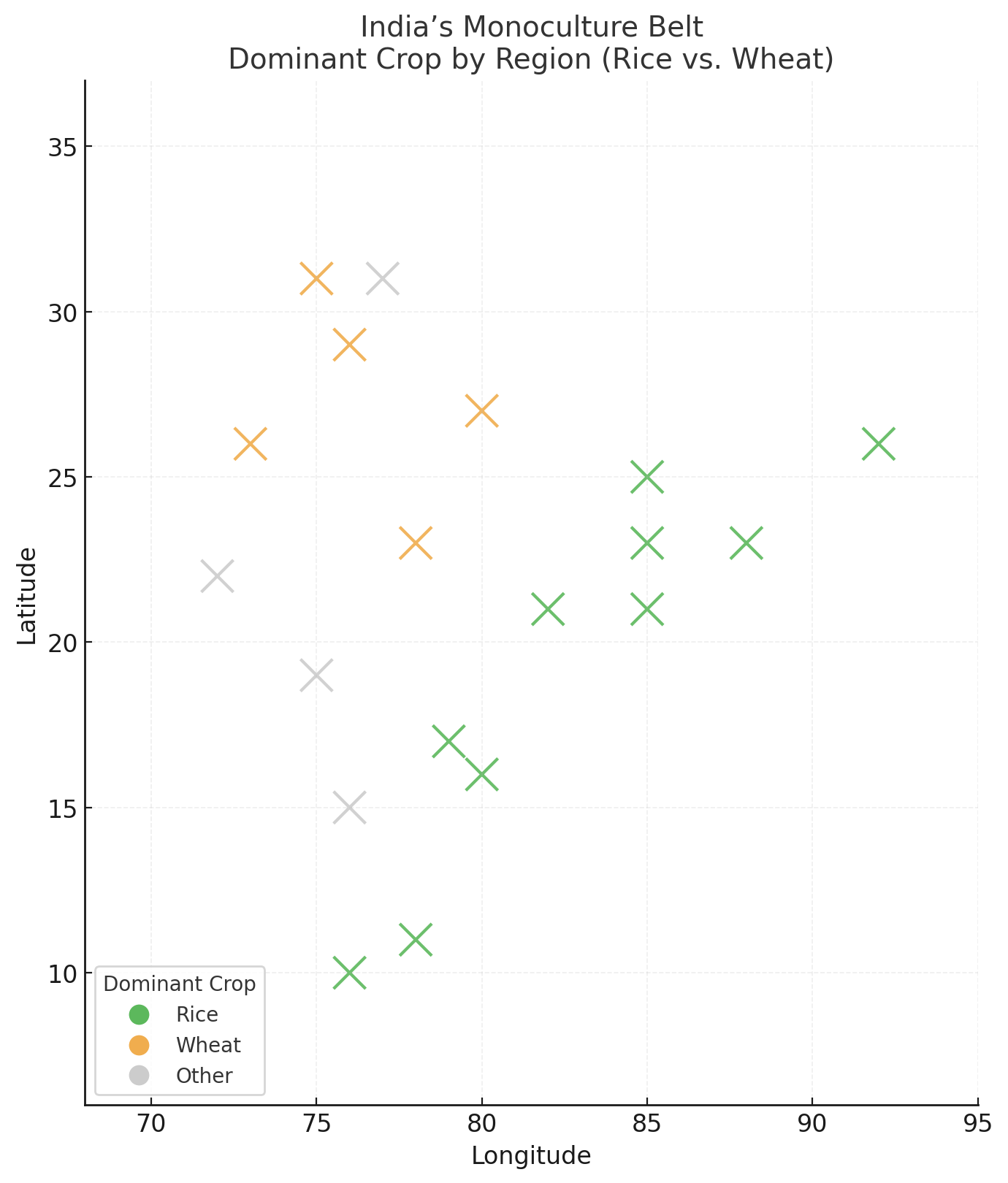
India’s Minimum Support Price (MSP) covers 23 crops. In practice, the government really only buys two in overwhelming quantities: rice and wheat. Why? To feed its Public Distribution System (PDS), which provides subsidized food to hundreds of millions. It must be said: this system, for all its flaws, has been instrumental in preventing the kind of famines that once haunted India. It is a monumental achievement in food security.
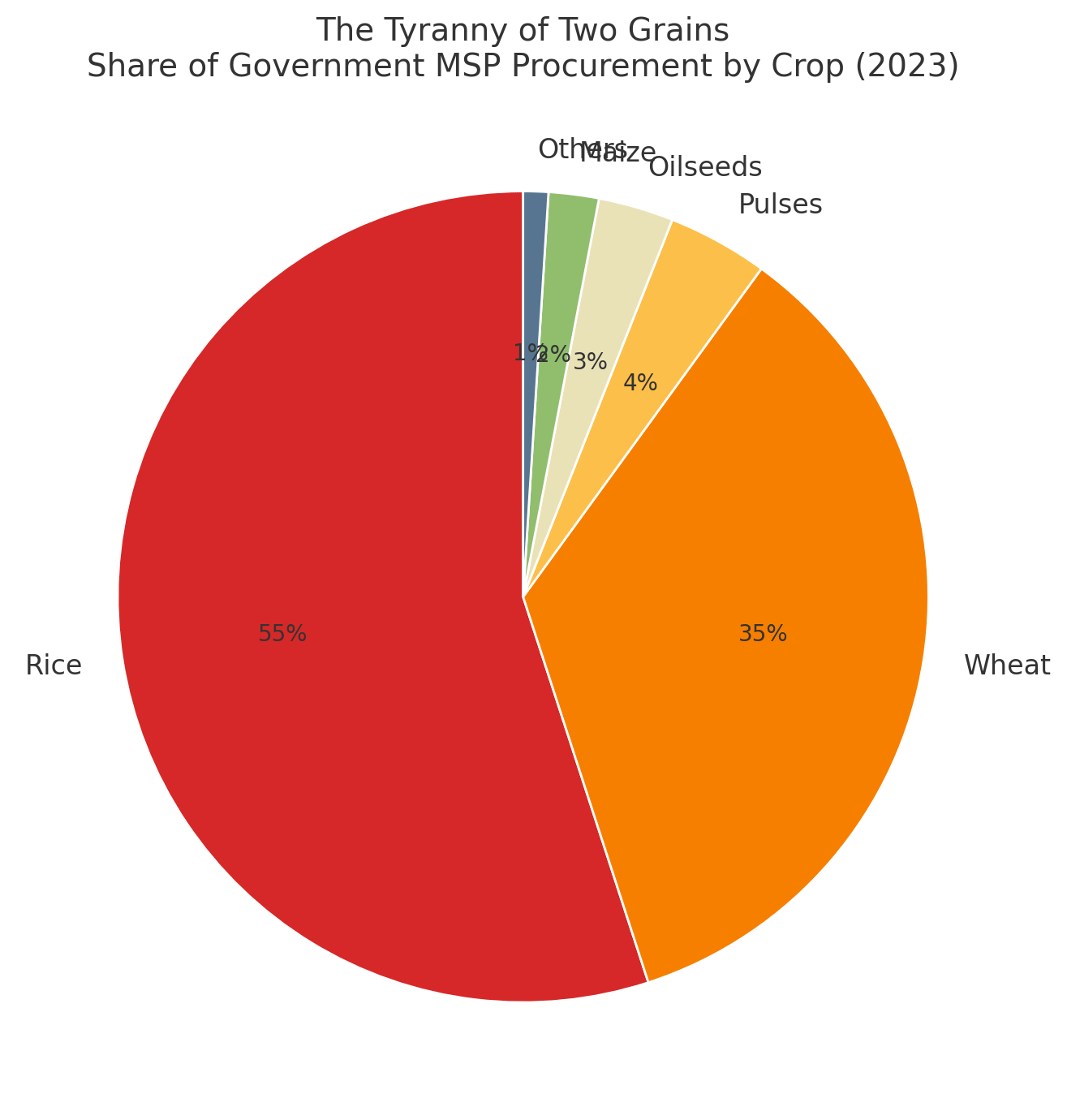
But this security has come at a price. As a farmer, you can grow vegetables, where the price might be high, or it might be zero. Or you can grow rice and wheat for a single, infinitely large, and completely reliable buyer. From an economic planner’s perspective, this is a distortion. From a farmer’s perspective, this is an economic choice born of the need for security. The result is a monoculture trap, ecologically ruinous but entirely rational.
The Small Farm Problem and the Unasked Question
Eighty-six percent of India’s farmers have less than two hectares of land. The average farm is tiny and getting tinier. There are no economies of scale, no bargaining power.
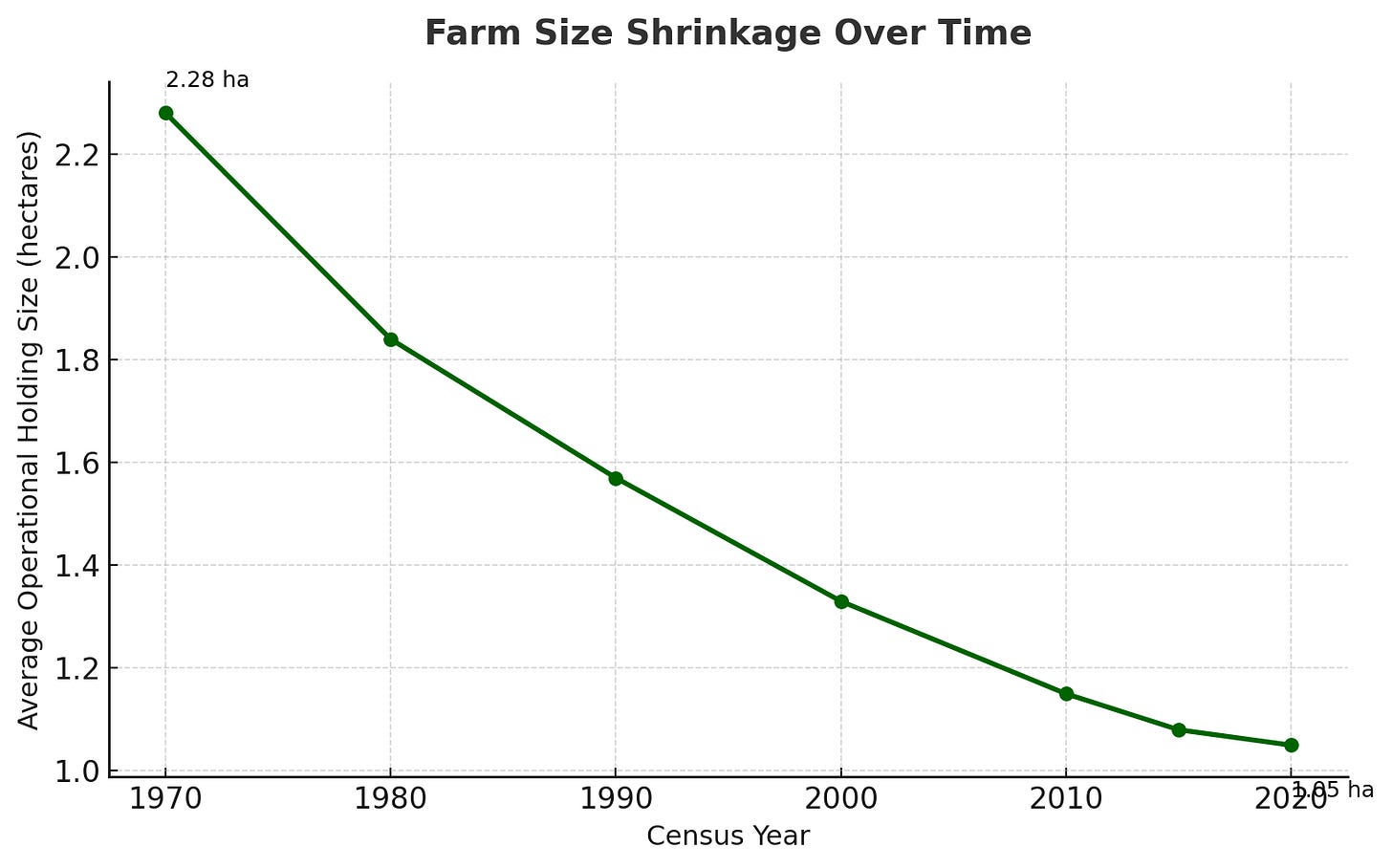
The textbook solution is consolidation and mechanization. But this tiptoes around the elephant in the room: Should India even have this many people farming?
Modernization implies that millions would have to leave agriculture. Where do they go? The Western model of vast, mechanized farms is not the only path, but the current system offers neither the productivity of that model nor the dignity of sustainable smallholding. It is a trap, designed to keep people on the land but not to let them prosper there.
Prescription (and its Discontents):
-
A Smarter Price Guarantee: Instead of buying all the grain, the government could pay farmers the difference if the market price falls below the MSP. The problem: This reduces the power of the vast state procurement agencies and the network of middlemen who thrive on the physical movement of grain.
-
Uber for Tractors: Shared equipment could help. The problem: This is a patch. It makes unprofitable farms slightly less unprofitable but doesn’t solve the fundamental issue of a fragmented, over-manned agricultural sector.
Part 3: The Post-Farm Stack: The Exhaust
After a farmer navigates the subsidy maze and market distortions, the machine’s final act is to destroy or devalue a huge portion of what they produce.
The Road to Ruin & The Mandi Maze
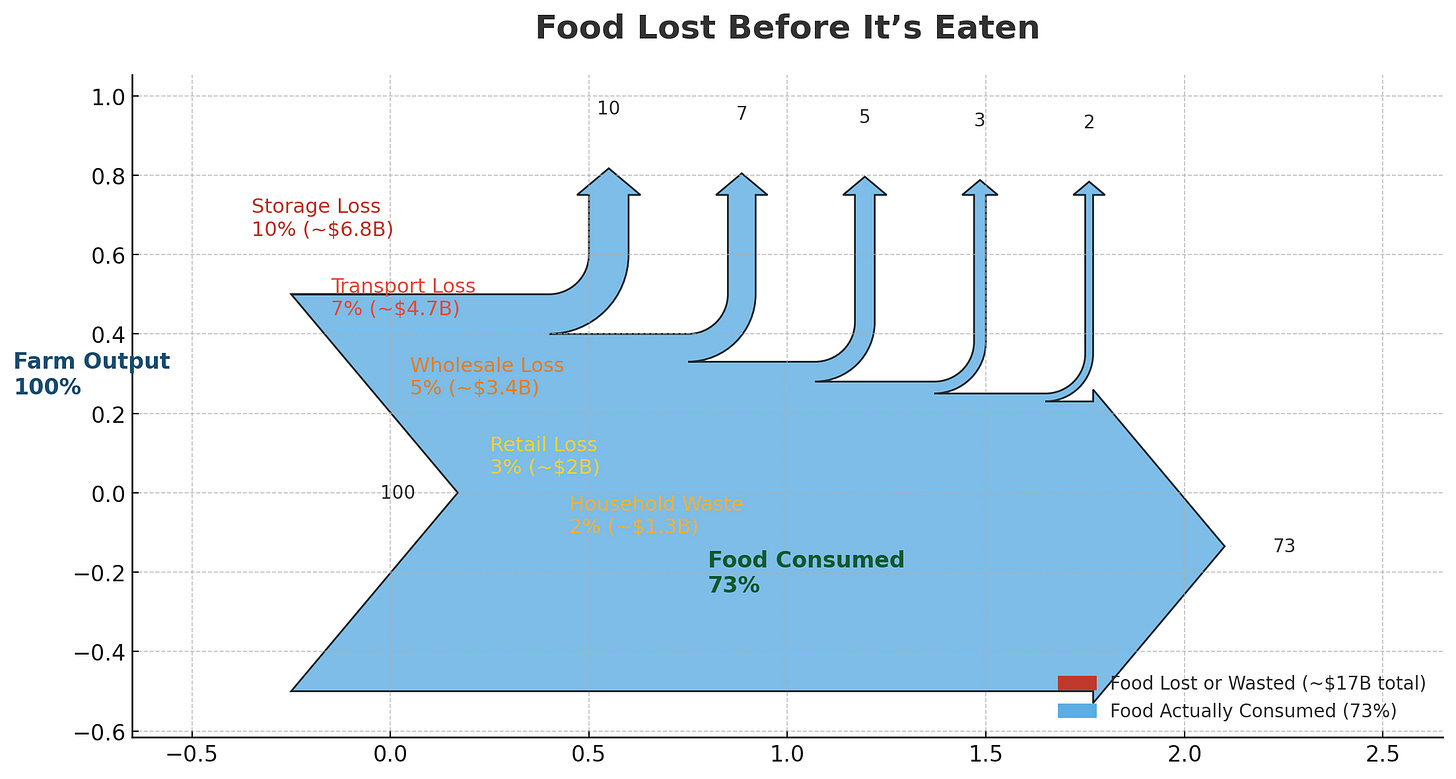
An estimated $17 billion a year is lost to spoilage, primarily due to a near-total lack of a cold chain. This forces farmers into the local mandi, a government-regulated market that has often devolved into a state-sanctioned toll road, run by cartels of commission agents. It’s socialism for inputs, capitalism for outputs, and chaos for everything in between.
This is why you get the bulldozers. The system is so inefficient that destroying your own product is sometimes the only rational choice.
Prescription (and its Discontents):
-
Build Some Damn Refrigerators: Public-Private Partnerships seem obvious. The problem: India has tried this. The $17 billion in spoilage is a massive opportunity, but it’s spread across millions of tiny transactions. To capture it, a business would need to solve for unreliable power, fragmented supply, and the local politics of the mandi cartels all at once. The risk is simply too high.
-
Make the Markets Transparent: Force all transactions onto an electronic platform. The problem: The entire mandi system runs on opacity. The cartels who run it are politically connected and will fight to prevent a system that would destroy their business model.
Part 4: The Guardians of the Machine
If the solutions are so well-known, why does the machine keep humming? Because it’s not broken. It was built to run exactly this way, guarded by those who feed on its output. This is not a story of policy failure but one of profound and definite political success.
The machine’s guardians are everywhere:
-
The fertilizer and power companies protecting their subsidy-driven markets.
-
The vast government procurement agencies commanding colossal budgets.
-
The commission agents in the mandis forming a powerful, localized political bloc.
-
And, most powerfully, political parties using loan waivers and subsidies as blunt, effective tools to win elections.
To “reform” this system is to declare war on all of them at once. And beneath all this lie the even deeper, foundational challenges, contested water rights, the historical injustices of land ownership, and the rigid social hierarchies of caste that dictate who has access to power. The machine is a political construct, designed to distribute patronage and maintain a fragile status quo.
Conclusion: A Perfectly Calibrated Machine
The labyrinth of India’s agricultural challenges is not, in the end, bewildering. It is the logical outcome of a system of perfectly aligned incentives just not aligned for the farmer or the nation. We engineered a system that grows wheat and debt with equal precision.
Every machine reflects its maker. This one reflects a state addicted to a form of control that masquerades as support. The tragedy isn’t its inefficiency but it’s ruthless efficiency at producing the political outcomes it was designed for.
In Kolar, the bulldozer’s blade glints under the sun. It is loud, but the real machine is the one that runs on subsidies, votes, and inertia. It roars with the sound of entrenched interests, daring anyone to switch it off.
Machines can be reprogrammed. But when a machine’s primary function is to distribute power, reprogramming it means redistributing power. That is not a technical problem. That is a revolution.
¹ Rube Goldberg was an American cartoonist famous for drawing absurdly complex machines that perform a very simple task. Think: a series of levers, rolling marbles, and a startled bird that all work together in a chain reaction to finally scratch an itch on your back. The point is that it’s a system where a simple, direct solution is replaced by a convoluted, multi-step process that barely works and has a ton of unintended consequences. It’s a perfect metaphor for a lot of government policy, really.