The Development Hedge Fund
Why Democracy Can’t Run the Asia Playbook (And Why India Needs a New One)
There’s a book that explains how Asia got rich, and it reads like a leaked investment memo from the world’s most successful, and most morally problematic, hedge fund. Joe Studwell’s How Asia Works is nominally a history of postwar East Asian development, but it’s really a case study in what happens when you give a ruthless general partner unlimited authority, captive capital, and a 30-year lockup period with no redemption rights.
The fund, which we might call Northeast Asia Developmental Capital, LP, generated returns that would make Jim Simons weep with envy. South Korea’s GDP per capita went from $280 in 1960 to $33,000 today. That’s a 118x return in 64 years, or roughly 7.8% annualized real growth. Taiwan did similar numbers. Japan rebuilt from literal ashes to become the world’s second-largest economy by 1980. The portfolio companies all started as impoverished, agrarian disasters. Most had just emerged from colonial occupation or civil war. And in a few decades, they became industrial powerhouses.
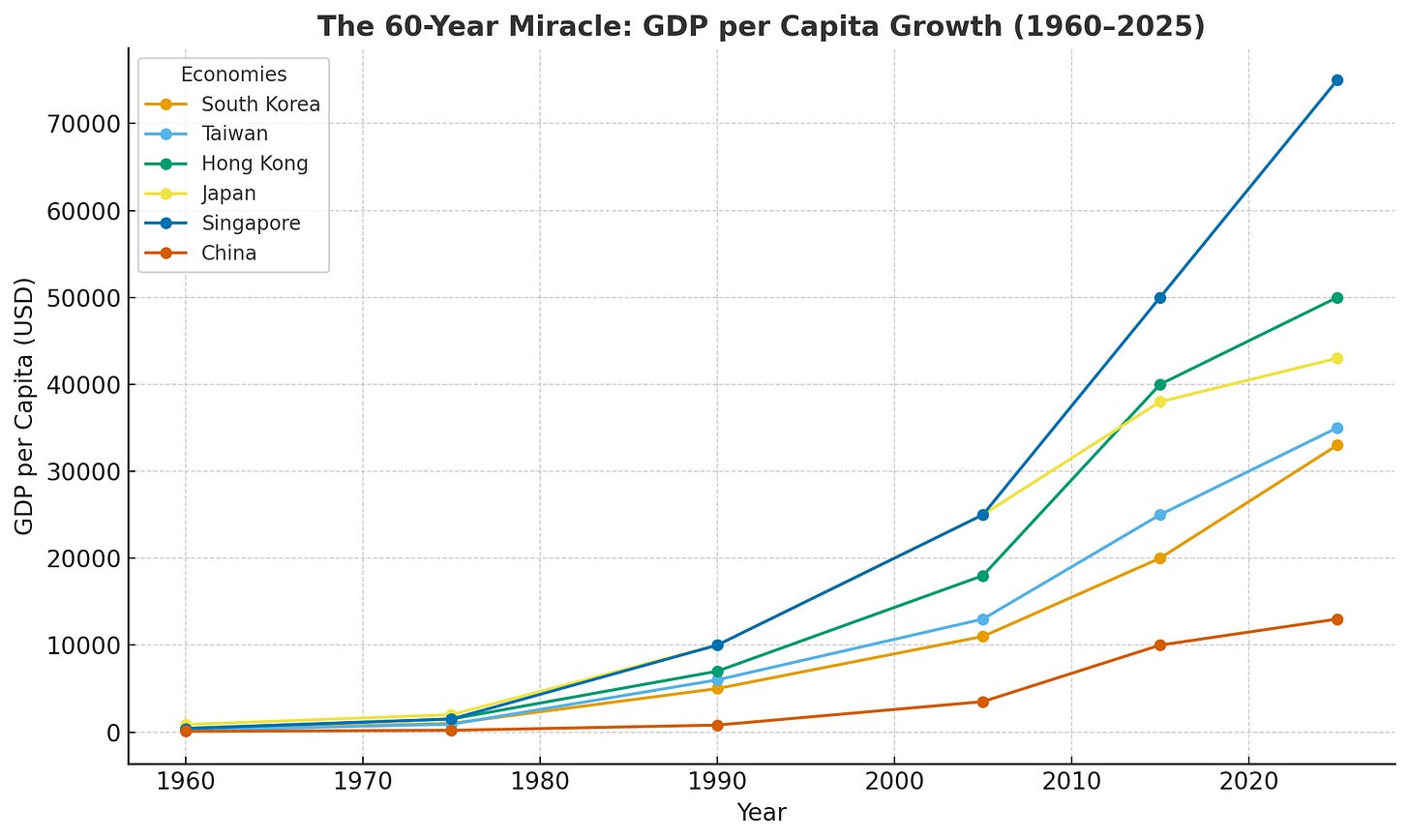
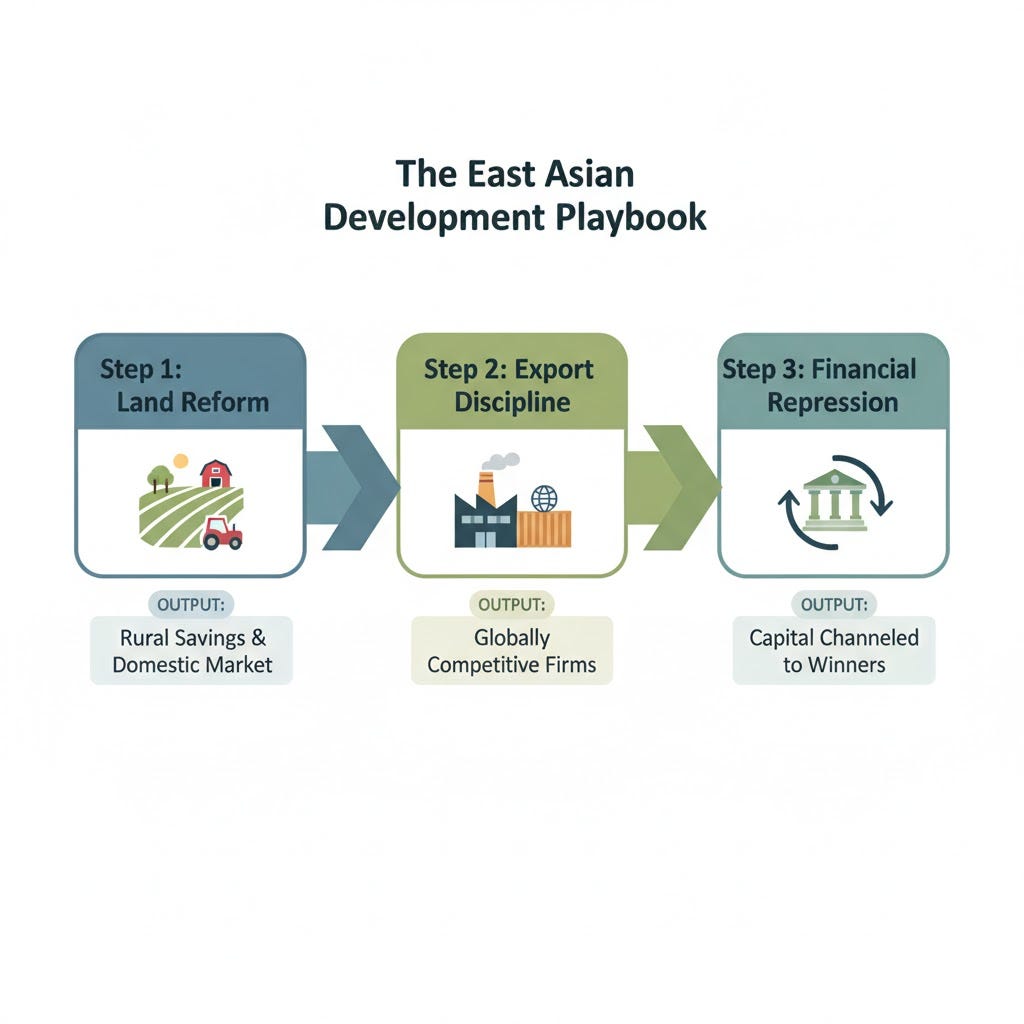
The strategy wasn’t a miracle. It was a three-part trade, executed ruthlessly, in sequence, with no tolerance for underperformance. Like all great investment strategies, it sounds simple in retrospect: maximize agricultural productivity to generate savings, channel those savings into export-oriented manufacturing, and use the financial system as a captive prime broker to enforce discipline. The magic wasn’t in the individual moves, but in the sequencing, the discipline, and the willingness to cut losers.
Then there’s India.
India in 1947 had the same starting conditions as South Korea in 1953 or Taiwan in 1949: poor, agricultural, desperate. By 2025, India’s GDP per capita is $3,000. Not 118x. Barely 10x. If Northeast Asia Developmental Capital was a hedge fund, India’s attempt to replicate the strategy was like watching someone read the Bridgewater pitch deck and then immediately violate every risk management rule while claiming they’re following the same playbook.
The standard explanation is that India “chose democracy over development” or got trapped in the License Raj. But this misses something deeper. This essay argues that the Studwell playbook requires political conditions of rapid expropriation of entrenched elites, sustained financial repression, and brutal creative destruction, conditions that are structurally incompatible with democracy at scale. India’s relative underperformance wasn’t a policy mistake you can fix with better technocrats. It was the inevitable result of trying to run an authoritarian investment strategy in a democratic system where the limited partners can fire the general partner every five years.
If this is right, the implications are uncomfortable. It means development economics has spent 70 years holding up a model that requires political conditions most countries can’t or won’t accept. It means the “East Asian Miracle” was less about smart policy and more about having the state capacity to ignore every constituency that would lose from rapid industrialization. And it means we need a completely different playbook for democratic development at scale, one we’re only beginning to understand.
Let’s start with what the original playbook actually required.
Part I: The Three Trades (Or, How to Expropriate Your Way to Prosperity)
Trade One: Going Long Small Farms (By Shorting Landlords)
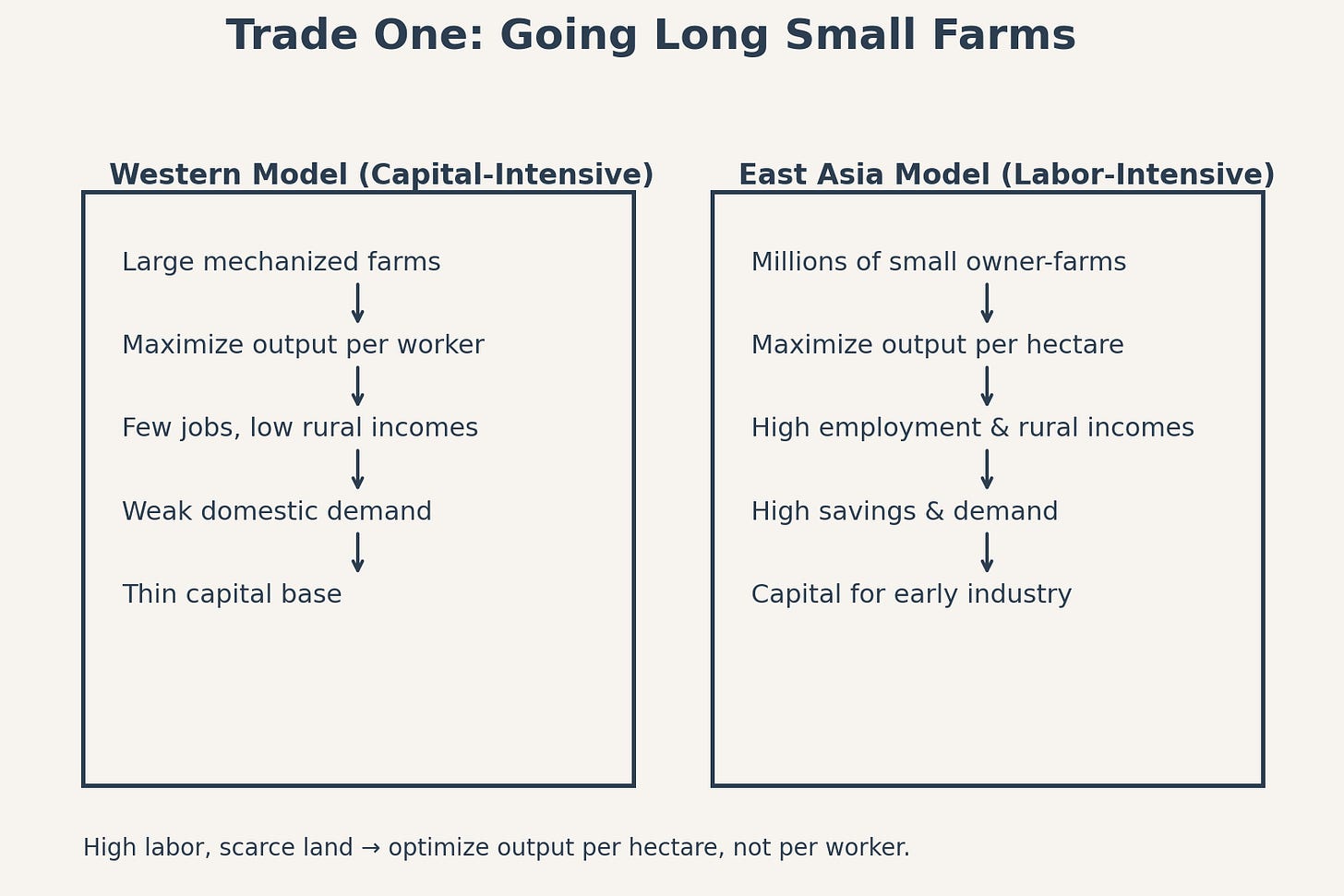
The first trade is the weird one, the one that trips up everyone who tries to replicate it. You don’t want big, efficient, American-style mechanized agriculture. You want what Studwell calls “gardening at scale,” meaning millions of small household farms, each family working two or three hectares with the intensity of someone tending a prize vegetable garden.
This is deeply counterintuitive if you think like a Western agricultural economist. The goal in a poor country with tons of people and very little capital isn’t output per farmer; it’s output per hectare. A 40-hectare mechanized wheat farm in Kansas employs maybe five people and produces 6 tons per hectare. Twenty families in Taiwan, each farming two hectares of rice plus vegetables and fruit, will use 15 times the labor and produce 12-15 tons per hectare of rice-equivalent output from the same amount of land.
The math works because labor is abundant and basically free, while land and capital are scarce. When you have 100 people and 10 hectares, the question isn’t “how do we minimize labor per unit of output?” but rather “how do we maximize output from our constrained land?” The answer is intensive, back-breaking household farming that only makes sense if you own the land and capture 100% of the marginal output from your effort.
Taiwan executed this perfectly. In 1949, the Kuomintang government, freshly defeated by Mao, terrified of communist land reform spreading to Taiwan, and under heavy American pressure, rolled out “Land-to-the-Tiller.” The government purchased land from landlords, compensating them with bonds in state-owned industrial enterprises, and sold it to tenant farmers on 10-year payment plans at 37.5% of annual crop value.
Rice yield per hectare shot from 1.9 tons in 1950 to 4.2 tons by 1970; agricultural productivity grew at 4.2% annually for two decades. 1 Within a generation, Taiwan went from food scarcity to food exporter. More importantly, you suddenly had millions of small farmers with cash income, which created a domestic consumer market. And those farmers saved at remarkable rates, 30–40% of income, which created the capital pool for the next trade.
South Korea followed an identical script in the 1950s under Syngman Rhee and then Park Chung-hee. The yangban aristocracy, Korea’s traditional landlord class, was broken. Land was redistributed. Agricultural productivity exploded.
This is Trade One: expropriate the landlords, create millions of small owner-cultivators, watch productivity and savings surge. It’s the foundation for everything else. Without it, you don’t have the domestic market or the capital base for industrialization. This is the LP base, the savings and demand that fund the rest of the strategy.
Trade Two: Export Discipline (Or, How to Run an Activist Fund)
The second trade is where the magic happens. Every developing country protects infant industries; that’s not interesting. What Northeast Asia did differently was combine protection with what Studwell calls “export discipline,” and this is the risk management mechanism that made the whole strategy work.
Here’s how it worked in South Korea under Park Chung-hee. The state would pick a chaebol, such as Samsung, Hyundai, or LG, and give it access to cheap credit from state-controlled banks, a protected domestic market, and import licenses for machinery. But the deal came with non-negotiable performance requirements: you must export, your export targets rise every year, and if you miss those targets, we cut you off.
This wasn’t a suggestion. Park’s Blue House held quarterly meetings where executives would present export numbers. If you missed your targets, you could lose your credit lines, your import licenses, your government contracts. The threat was credible because Park actually did cut off firms that failed. Daewoo collapsed under a mountain of debt when it couldn’t compete globally, and the government let it die.
When Hyundai launched the Pony in 1976, their first passenger car, it was a disaster. Build quality was terrible. It was literally laughed out of the Canadian market. The Blue House was furious. Park threatened to withdraw state support.Hyundai had no choice, so they hired Italian designers from Italdesign, licensed technology from Mitsubishi, and spent the next decade ruthlessly improving their production systems. By the late 1980s, they were exporting globally competitive vehicles.
Why does this work when pure protectionism fails?
Because export markets provide information that domestic politics can’t. If your car company can’t sell vehicles in Hamburg or Chicago, it’s not because Germans are biased or there’s a conspiracy against you. It’s because your cars are too expensive or poor quality compared to Toyota and Volkswagen. The market is an impartial referee. It doesn’t care about your political connections or how many workers you employ in the president’s home district. Either foreigners buy your products or they don’t.
This is the genius of export discipline as a sorting mechanism: it depoliticizes industrial policy. You’re not asking politicians or bureaucrats to judge which firms are “good” based on vibes or lobbying. You’re outsourcing that judgment to global markets. The Germans and Americans don’t take bribes from Korean firms. They just want the best product at the best price.
This is also the risk management. In a fund, you don’t make concentrated bets without stop-losses. Export discipline is the stop-loss. If your portfolio company can’t compete globally within a defined timeframe, you cut it off and reallocate capital to winners. No permanent life support for connected failures.
Trade Three: Financial Repression (Or, Your Banks Work for the GP, Not for LPs)
The final trade is the capital structure. You turn your entire banking system into a direct allocation mechanism for industrial policy.
Taiwan and South Korea didn’t have “financial sectors” in the modern sense. They had state-controlled credit allocation systems. Interest rates were kept artificially low, often below inflation, meaning negative real rates. Banks were explicitly prohibited from lending for consumption, real estate speculation, or trade finance. Their job was to channel the savings generated by Trade One into long-term, low-interest loans for the exporting manufacturers you picked in Trade Two.
This is “financial repression,” which sounds bad but in this context was absolutely critical. In capital-scarce economies, if you let banks allocate credit based on risk-adjusted returns, they’ll fund whatever has the fastest payback: real estate, consumer lending, working capital for traders. They won’t fund 10–15-year manufacturing projects with uncertain returns, even if those projects are what you need for industrialization.
So you don’t let them choose. The state directs capital allocation. Banks become utilities: boring, obedient pipes that move savings from households to the manufacturing firms that are meeting their export targets.
This only works if you have Trade One’s domestic savings to channel and Trade Two’s export discipline to prevent the banks from becoming slush funds for politically connected borrowers. Remove any leg of this tripod and the whole thing collapses.
Part II: Why India Couldn’t Execute (The Structural Problem)
Now we get to India, and here’s where it gets uncomfortable.
The conventional story is that India had bad policy: the License Raj, Nehruvian socialism, crony capitalism. Get better technocrats, remove the controls, and you’d get South Korean results. This is what the Washington Consensus believed in the 1990s. This is what the World Bank still sort of believes.
I think this is wrong. I think India couldn’t execute the Studwell playbook not because of bad policy choices, but because the playbook requires political conditions that large democracies structurally cannot sustain. Let me show you why.
The Land Reform That Couldn’t Happen
Start with Trade One. India in 1947 had the perfect moment for land reform. The British were gone. The zamindari landlord class had collaborated with colonial authorities and had zero nationalist legitimacy. Nehru genuinely wanted land reform, as he had promised it during the independence movement. The political window was wide open.
And yet.
Here’s what actually happened. Congress passed land reform laws in the early 1950s: the abolition of zamindari intermediaries and then land ceiling acts to cap individual holdings. On paper, this looked like Taiwan’s land reform. In practice, it was theater.
The laws were riddled with loopholes that landlords immediately exploited. Land ceilings applied to individuals, not families, so zamindars simply divided their holdings on paper among relatives. There were exemptions for “plantations,” so suddenly every large holding became a mango or coconut plantation. Landlords evicted tenant farmers before the laws took effect, knowing that tenancy rights only applied if there was documentary proof, which informal tenants rarely had. By the time the legal process finished, the old landlord class had preserved most of their holdings while the laws had technically been “implemented.”
In Uttar Pradesh and Bihar, India’s most populous states, land reform essentially failed. By 1970, large holdings were nominally smaller on paper, but economic control remained concentrated. The small farmers who were supposed to benefit remained tenant farmers or landless laborers. Agricultural productivity growth averaged 1.8% annually through the 1950s and 1960s, less than half of Taiwan’s 4.2%.
Why did this happen?
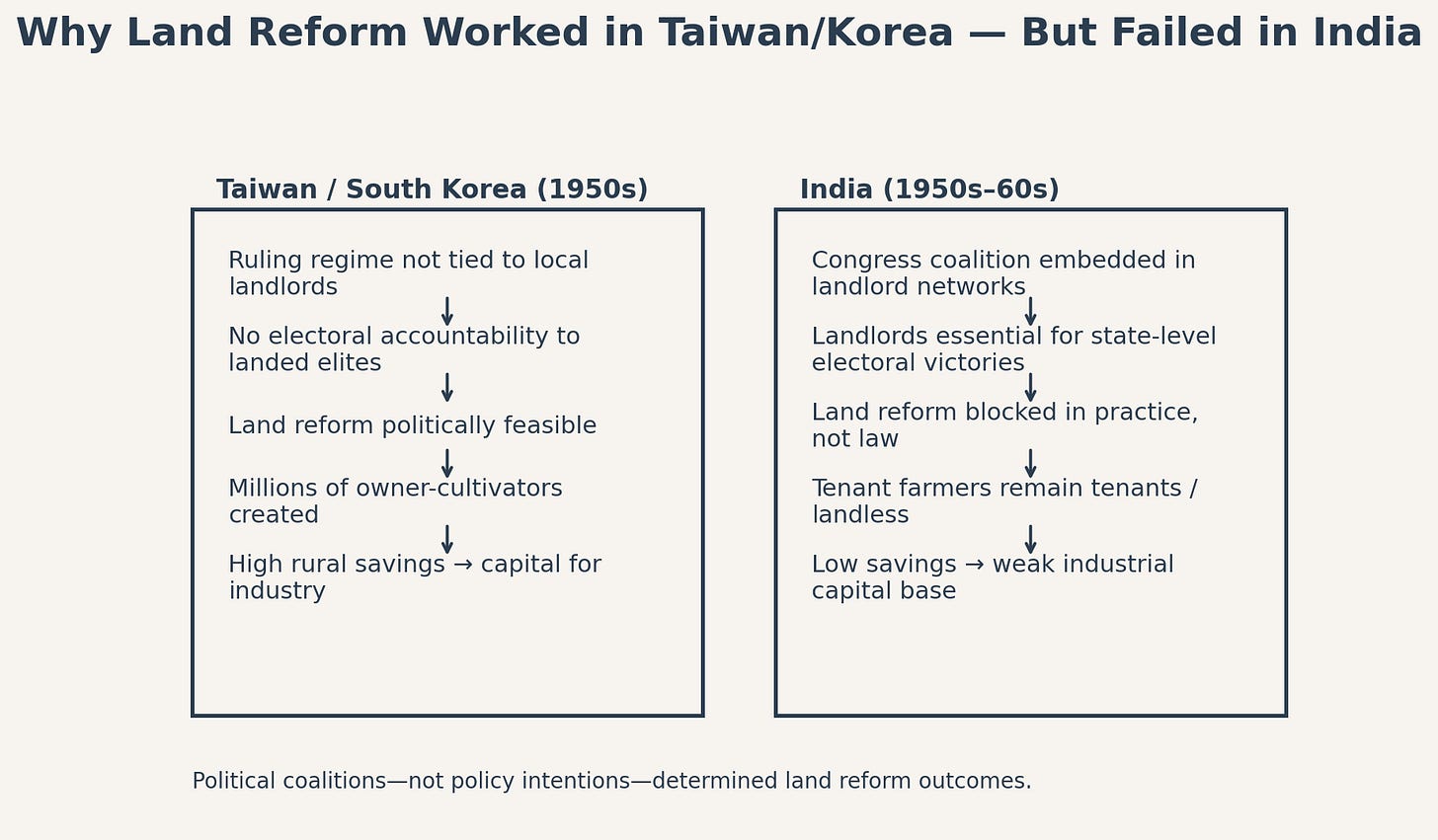
The standard explanation blames weak state capacity or corruption, but that’s incomplete. The deeper answer is that Nehru couldn’t afford to break the landlord class because he needed them for political survival in a democracy.
Compare the political economy:
Taiwan’s KMT was an external regime with no organic ties to local landlords. They’d just lost mainland China partly because they failed to do land reform there and communist land redistribution proved devastatingly popular. They ruled Taiwan under martial law with American military backing. When they expropriated landlords, the landlords couldn’t vote them out, because there were no meaningful elections. The only question was whether the Americans would back them, and the Americans were demanding land reform as the price of support.
India’s Congress was a broad nationalist coalition that had just won independence through decades of organizing across every region and class. The party’s state-level bosses were often themselves landlords or dependent on landlord support. In a democracy with universal suffrage, Congress needed those landlords’ money, organizational networks, and ability to deliver rural votes. Nehru at the national level wanted land reform; Congress state leaders needed to maintain their coalitions. The result was laws with no enforcement.
This is not a story about corruption; rather, it is about democratic accountability to existing elites that makes expropriation impossible. When you give the people who would lose from land reform a voice and a vote, they use that voice and vote to protect themselves. This is what democracy means.
But there’s something deeper going on. Nehru didn’t just compromise with landlords because of political constraints. He fundamentally misunderstood what development required, and his intellectual errors were typical of mid-century development thinking.
Nehru’s Fabian Blindness
Read Nehru’s speeches and writings on agriculture in the 1950s. What excited him? Tractors. Large state farms. Mechanization. Irrigation mega-projects. When he visited the Soviet Union in 1955, he was dazzled by giant collective farms and their (fabricated) productivity statistics.
Nehru’s intellectual formation was Fabian socialism crossed with Soviet-style central planning. He genuinely believed that large-scale, mechanized, state-organized agriculture was superior to small household farming. Small farms were backward, traditional, feudal. Modernity meant tractors and scientific farming at scale.
Even if Nehru had faced zero political constraints from landlords, he likely would not have pursued Taiwan-style land redistribution because he didn’t believe in the model. He thought the path to development ran through heavy industry: steel mills, dams, machine tools. Agriculture would modernize through mechanization, not redistribution.
In a democracy, bad ideas can persist longer than they would under authoritarian trial-and-error because there’s no forcing mechanism for rapid course correction. China’s Great Leap Forward killed 30-45 million people through famine in 1959-61, and the catastrophe was so immediate and undeniable that even Mao had to partially reverse course. India’s approach was less catastrophic but also less correctable; mediocre agricultural productivity growth didn’t create mass death, so there was no crisis moment forcing a rethink. The system could limp along for decades.
By the time the Green Revolution came to India in the late 1960s, it brought higher-yielding crop varieties and chemical fertilizers primarily to Punjab and Haryana, resulting in a technology-led productivity increase rather than a redistribution-led one. It prevented famine, but it didn’t create the broad-based rural prosperity and savings that Taiwan’s land reform generated. The Green Revolution happened in pockets; Taiwan’s land reform transformed the entire rural economy.
Why Export Discipline Couldn’t Work in a Democracy
Suppose India had somehow achieved successful land reform and Nehru had understood its importance. Could India have executed Trade Two: export discipline?
Almost certainly not, and the reason illuminates the deepest incompatibility between the Studwell playbook and democracy.
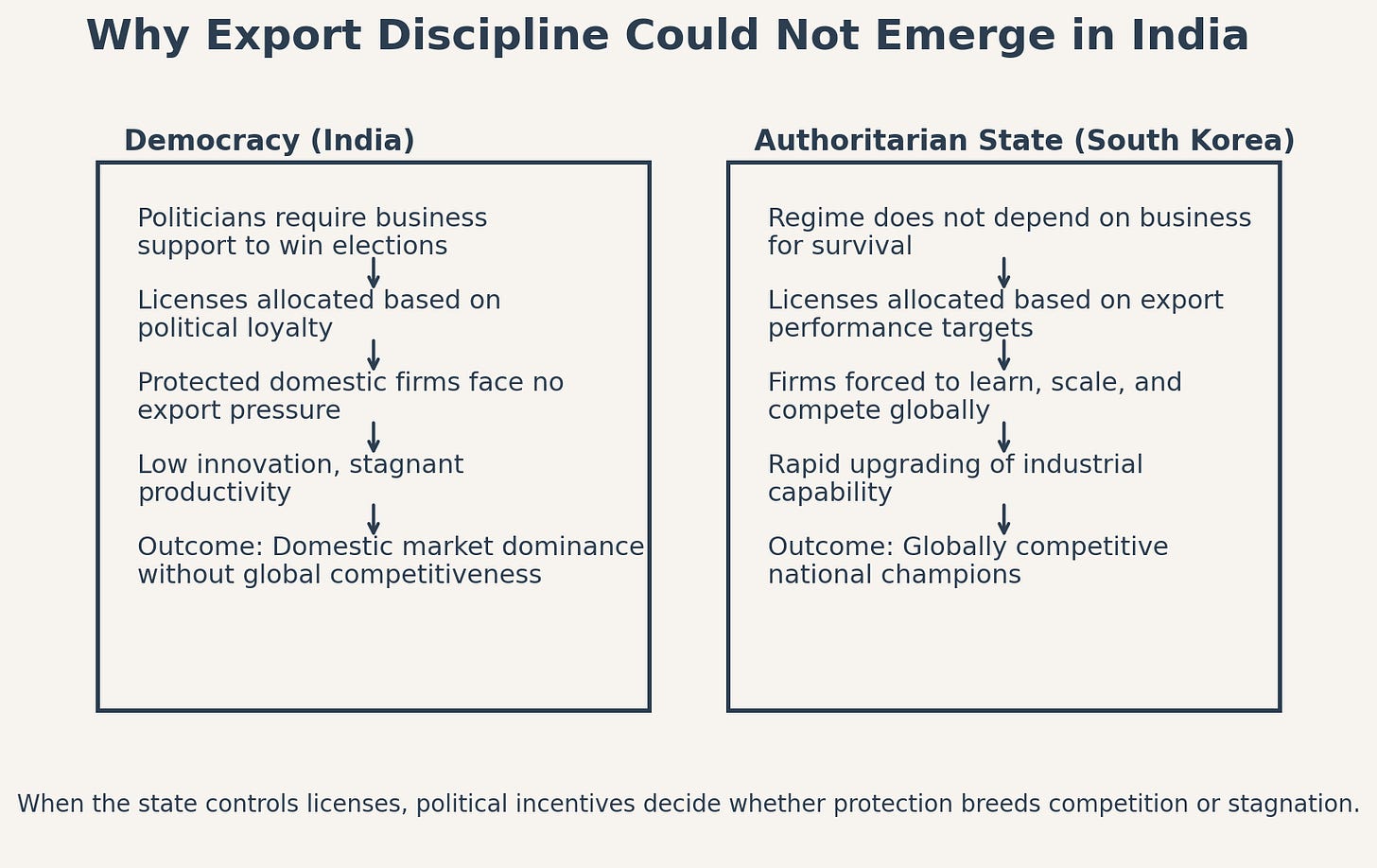
The License Raj wasn’t a mistake—it was the equilibrium outcome of democratic industrialization in a capital-scarce economy.
Think through the political economy step by step:
-
You’re a developing country in 1950 with limited foreign exchange. You need to import machinery and raw materials to industrialize, but you can’t afford to import everything everyone wants.
-
So, you implement import licensing to ration scarce foreign exchange: it’s economically sensible, and every developing country did it.
-
But now every business needs a license to import machinery, expand production, or enter new markets. The licenses become the most valuable economic asset in the country because they’re the binding constraint on growth.
-
Businesses that get licenses make fortunes. Businesses that don’t get licenses fail. The ability to grant or deny licenses becomes the ultimate political currency.
-
In a democracy, politicians need businesses to fund campaigns, deliver employment to key constituencies, and provide support during elections. Businesses need politicians to grant them licenses.
This creates a natural bargain: politicians grant licenses to businesses that support them politically, and those businesses use their license-enabled profits to support their political patrons. This isn’t corruption in the simple sense but more of a predicted equilibrium when (a) the state controls access to the binding constraint on growth and (b) politicians need resources to win democratic competition.
Now contrast this with South Korea under Park Chung-hee. Park’s regime also controlled licenses and credit. But Park didn’t face elections. He didn’t need Samsung or Hyundai’s political support. He took power in a military coup and maintained it through authoritarian control. This meant he could impose non-negotiable performance requirements.
If Samsung missed export targets, Park could threaten to cut off their credit lines, and Samsung couldn’t respond by funding his opponent in the next election because there was no next election. Park’s time horizon was “build a modern economy before North Korea beats us,” not “win the next election cycle.” The Investment Committee (Korea’s Economic Planning Board) could evaluate firms purely on export performance without worrying about political blowback.
In India, export discipline was structurally impossible because democratic politicians needed business support and businesses provided that support in exchange for protection from competition.
The story of Dhirubhai Ambani and Reliance Industries illustrates this perfectly. Ambani built Reliance into India’s largest private conglomerate not primarily through operational excellence but by mastering the license system. In the 1970s and 1980s, when Reliance wanted to expand polyester production capacity, Ambani cultivated relationships with politicians across parties. His license applications got approved; his competitors’ applications got delayed or denied.
This wasn’t illegal. This was how the system worked. Ambani employed tens of thousands of workers in politically important states. He funded politicians’ campaigns. In return, those politicians ensured the License Raj worked in his favor. Reliance didn’t need to compete on global markets because it had a protected domestic market. And it had that protected market because democratic politicians needed Reliance’s political support.
The Hindustan Ambassador, the car that remained virtually unchanged from 1958 to 2014, wasn’t an amusing anachronism. It was the symbol of what happens when you combine protection with democracy. Hindustan Motors had a captive market, political connections, and no pressure to improve. Why would they innovate? There was no export requirement forcing them to compete globally. When India finally opened up in the 1990s, the Ambassador died within a decade.
The Banking System: Cronyism Without Discipline
Now add captured finance to the mix. In 1969, Indira Gandhi nationalized India’s major banks with genuine developmental intent: she wanted to direct credit to underserved sectors and regions. This was supposed to be India’s version of Taiwan and South Korea’s directed credit.
What emerged was cronyism with socialized losses: all the capital misallocation of crony capitalism, but with taxpayers holding the bag.
The paradigmatic case is Vijay Mallya’s Kingfisher Airlines. Between 2005 and 2013, a consortium of state-owned banks, led by State Bank of India, Punjab National Bank, and Bank of Baroda, lent Mallya over $1.4 billion to fund Kingfisher Airlines even as the airline posted mounting losses and showed clear signs of failure. When the airline collapsed in 2012, Mallya fled to London. The banks wrote off most of the debt. Indian taxpayers absorbed the loss.
This wasn’t unique. By 2018, India’s banking system had reached 11 percent non-performing assets, meaning one in nine loans wasn’t being repaid. Steel, infrastructure, textiles, and real estate firms with political connections borrowed aggressively from state banks with the implicit understanding that those connections would prevent foreclosure. These “zombie firms” kept operating and burning capital, because calling in the loans would mean admitting the losses and potentially facing political consequences for cutting off employment in key constituencies.
Why didn’t India have South Korea’s disciplined developmental banking?
South Korean banks answered to economic bureaucrats who answered to Park Chung-hee, whose mandate was to build firms that could export. Export performance was the metric. If a firm could not compete globally, it did not receive renewed credit. The system could enforce this because Park did not face democratic accountability.
Indian banks answered to finance ministers who needed to maintain political coalitions, state governments that demanded credit for local industries, business houses with connections across parties, and MPs whose constituents needed loans. Every lending decision became a political negotiation. Export performance could not be the deciding metric because export performance was not what determined whether a politician kept their job.
In fund terms: the GP, the state, could not impose discipline on portfolio companies because the LP base, the voters, demanded that capital be distributed based on political criteria rather than performance.
Part III: The American Client State Advantage (Or Most of the Alpha Was Geopolitics)
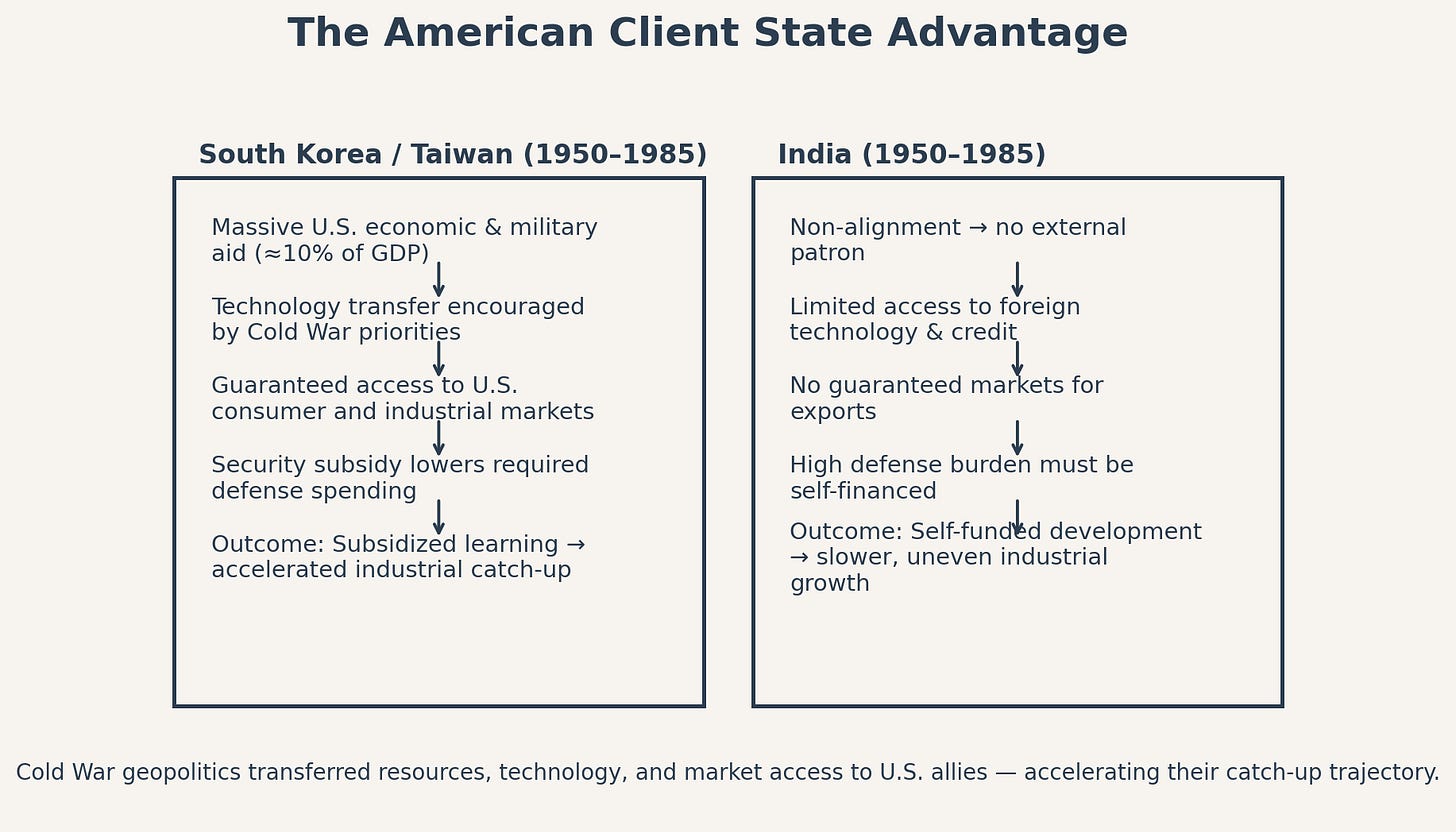
But there is something else going on in the Northeast Asia story, something Studwell underplays because it complicates the “good institutions matter” narrative. These countries were frontline Cold War states, and the United States essentially paid them to develop.
Consider what South Korea received: More than $60 billion in economic and military aid from 1946 to 1978 (inflation-adjusted), amounting to roughly 10 percent of South Korea’s GDP annually through the critical 1950s and 1960s. This was not a loan; it was a transfer.
Technology transfer operated as Cold War strategy. American firms were pressured to license technology to Korean firms. When Hyundai needed automotive technology, Mitsubishi provided it partly because the United States encouraged technology sharing with anti-communist Asian allies. When Samsung wanted to enter semiconductors, it received technology from American firms that had been told that helping Korea mattered for Cold War strategy.
Market access was guaranteed. The United States tolerated Korean protectionism at home while keeping American markets open to Korean exports during the exact decades, the 1970s and 1980s, when Korean firms were learning to compete. Korean steel, ships, and automobiles received preferential access to American buyers.
Intellectual property violations were tolerated. Washington looked the other way when Korean firms reverse-engineered American and Japanese products. The prevailing attitude was that Korea needed to succeed as a counterweight to communism.
There was also a security subsidy. The U.S. military presence meant South Korea could spend 3 to 4 percent of GDP on defense instead of 8 to 10 percent. The difference funded industrial investment. Japan received the same advantage.
Taiwan received similar treatment: massive American aid, guaranteed security against the mainland, technology transfer, and access to American markets and universities.
India was non-aligned. Not only did it not receive this support, it faced periods of active American opposition. In 1971, when India went to war with Pakistan to stop the genocide in Bangladesh, Nixon sent the USS Enterprise carrier group into the Bay of Bengal as a threat. The United States repeatedly denied India access to technology and credit that it freely provided to Cold War allies.
How much did American support matter? We can try to quantify it.
-
Direct aid: Remove more than $60 billion in transfers, which amounted to 8 to 10 percent of GDP during the formative years. This reduction likely cuts growth by 1.5 to 2 percentage points annually between 1950 and 1970.
-
Technology transfer: Without American-encouraged licensing, Korean firms would have needed an additional 10 to 15 years to develop indigenous capabilities in automobiles, semiconductors, and machinery. This delay likely reduces growth by another 1 to 1.5 percentage points annually.
-
Market access: If Korean exports had faced the typical protectionism imposed on developing countries, export growth in the 1970s and 1980s would have been 30 to 40 percent lower. This likely costs 1.5 to 2 percentage points of annual growth.
-
Security subsidy: Without the U.S. security guarantee, Korean defense spending would have needed to be 7 to 8 percent of GDP instead of 3 to 4 percent. This reallocation likely reduces growth by an additional 0.5 to 1 percentage point annually.
The rough total is a reduction of 4 to 6 percentage points of annual growth during the critical decades.
Over 30 years, that is the difference between a 10 percent growth rate, which Korea achieved, and a 4 to 6 percent rate, which India achieved. It is the difference between a 118x increase in per capita income and perhaps a 35x to 40x increase, still impressive but much closer to India’s actual performance.
The estimate is that geopolitics explains 40 to 60 percent of the Northeast Asian growth miracle. The Studwell playbook mattered, but it mattered far less than having an external patron willing to transfer enormous resources, technology, and market access as Cold War strategy.
The uncomfortable implication is that we cannot cleanly separate “good policy” from “favorable geopolitical conditions.” The Northeast Asia playbook worked in small countries that had both authoritarian governments capable of imposing discipline and American sponsorship during the Cold War. We have very few examples of it working without both conditions.
India had neither. It was democratic, which prevented the authoritarian discipline the playbook required, and it was non-aligned, which meant it developed without the geopolitical subsidy that made the aggressive export-oriented strategy viable for America’s Cold War clients.
Part IV: The China Test (Proof at Billion-Person Scale)
The obvious objection to my thesis is China. If the Studwell playbook only works in small authoritarian Cold War client states, how did China, a billion-person country that started poorer than India in 1978, become the world’s factory?
This validates the thesis rather than contradicting it.
When China began market reforms in 1978, it was poorer than India (GDP per capita $150 vs. $200). By 2024: China’s $13,000, India’s $2,500. China achieved an 87x increase over 46 years versus India’s 12.5x.
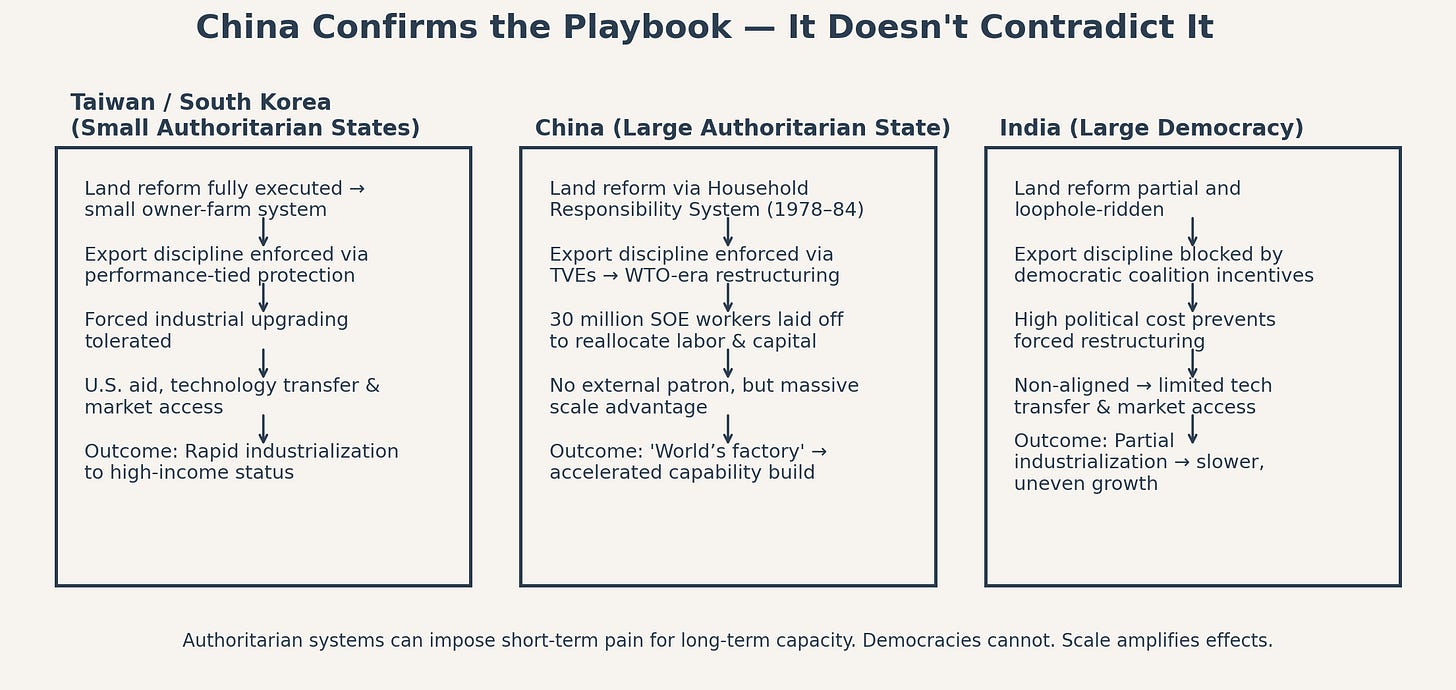
China executed the Studwell playbook completely. Land reform through the Household Responsibility System (1978–84) restored small-scale farming, and grain production increased 50 percent in a decade.2 Export discipline was enforced through Township and Village Enterprises and later through WTO accession in 2001, accompanied by brutal restructuring in which more than 30 million state-owned enterprise workers were laid off in the 1990s, the largest forced industrial restructuring in history. 3 Financial repression channeled cheap, state-directed credit through state-owned banks to export-oriented firms.
Why could China do this when India couldn’t? Three reasons: (1) Authoritarian control let the CCP impose enormous short-term costs without facing elections. (2) Starting late meant copying existing technology rather than inventing it. (3) Scale advantages: a billion people mean massive domestic markets plus export capacity.
But the core factor was political. No democracy could have laid off 30 million workers in a decade and survived. The Party evaluated provinces and firms on economic performance and shut down failures without worrying about losing power.
What China proves: The playbook works at billion-person scale under authoritarianism. The uncomfortable question: if China democratizes before reaching high-income status, will the model break? South Korea and Taiwan democratized after becoming rich ($12,000-15,000 per capita). China is at $13,000 but with much less equal distribution. The CCP’s bet appears to be stay authoritarian until $25,000-30,000 per capita, then consider reform.
Part V: The Counterfactual That Matters (Could Democracy Ever Do This?)
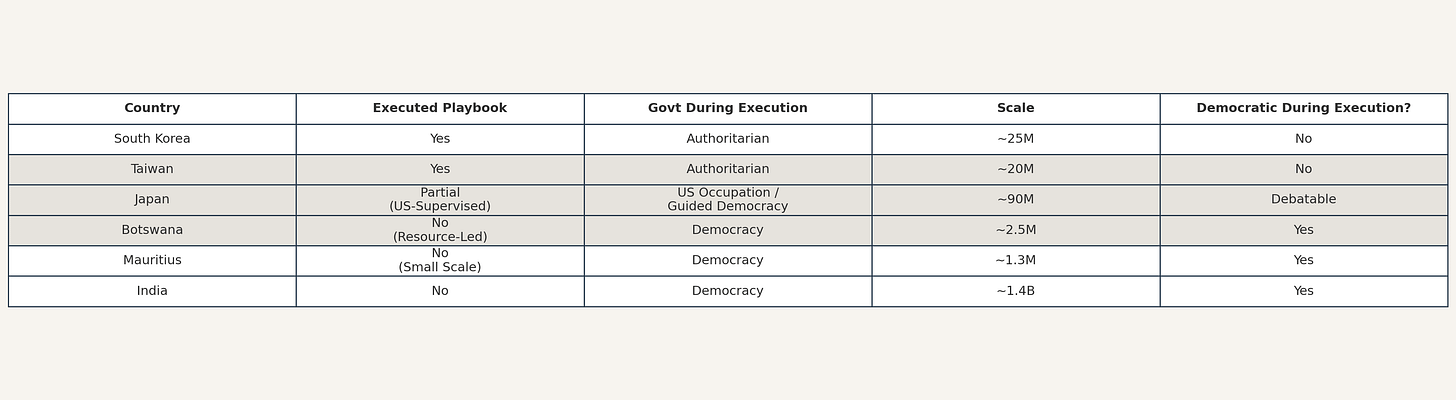
The thesis is that the Studwell playbook requires authoritarianism. Let’s test it directly: Has any large democracy ever executed all three trades successfully while remaining democratic throughout the process?
Go through the candidates:
-
South Korea: Executed the playbook under Park Chung-hee’s dictatorship (1961-1979) and his successor Chun Doo-hwan (1980-1987). Democratized in 1987, after becoming middle-income. Doesn’t count.
-
Taiwan: Executed under KMT martial law (1949-1987). Democratized in the 1990s, after industrialization succeeded. Doesn’t count.
-
Japan: Was democratic post-1945, but under American occupation with industrial structure determined by SCAP. The zaibatsu were broken up and reformed as keiretsu by American directive. Not clear this was “democratic” in the meaningful sense during the critical initial period.
-
Botswana: Maintained democracy and grew well, but it’s resource-funded (diamonds are 20-30% of GDP). Resource rents do what land reform does: they create an automatic savings base. Also, it’s a country of 2.5 million people. Not relevant at India’s scale.
-
Mauritius: Similar story: successful, democratic, but irrelevant at scale (1.3 million people).
-
Post-1991 India: Liberalized significantly, maintained democracy, but didn’t execute any of the three trades properly. No land reform, export discipline still weak, banking system only recently becoming disciplined.
The pattern is clear: No large democracy has ever executed the full Studwell playbook while remaining democratic during the execution phase.
Small, ethnically homogeneous democracies can sometimes do disciplined development policy. But large, diverse democracies face insurmountable coordination and commitment problems:
Bargaining complexity: Land reform in India required negotiation across 28 states with radically different agrarian systems. Each state had entrenched landed elites who could block reform through state-level political machines. In South Korea, Park Chung-hee could simply decree land reform nationwide. In India, Nehru had to negotiate with state-level Congress bosses who owed their positions to landlord support.
Credible commitment: Authoritarian regimes can commit to long-term policy because there’s no election that might reverse course. Park could tell chaebols “we’re committed to this export strategy for 20 years” and it was believable. Indian firms in the 1950s-70s had no reason to believe any policy would survive the next election or the next prime minister. Why invest in building export capability when the rules might change in five years?
Compensation costs: Radical reform creates concentrated losers. In small countries, winners can compensate losers (Taiwan compensated expropriated landlords with industrial bonds). In India, the scale of compensation needed to buy out all landlords or restructure all failing industries exceeded state fiscal capacity. The only way to do it was through expropriation, which democracy made politically impossible.
This leads to an uncomfortable conclusion: The Studwell playbook may be structurally incompatible with democracy at large scale, not because democracies are incapable of making smart policy, but because the specific policies required (rapid expropriation, sustained financial repression, brutal creative destruction) create too many losers in large, diverse polities, and democratic accountability to those losers makes the policies unsustainable.
But I want to be precise about the claim. I’m not arguing that democracies can’t develop or that authoritarian development is “better.” I’m arguing something narrower: This specific playbook, the three trades executed in sequence with ruthless discipline, requires authoritarian state capacity. Democracies that want to develop need a different playbook.
India’s challenge is that it spent 40 years attempting to run the authoritarian playbook through democratic means, producing the worst of both worlds: bureaucratic control and protectionism without the discipline. What India needs is a playbook designed for democratic constraints from the outset.
Part VI: The Services Accident (Or, What If Manufacturing-First Development Is Obsolete?)
Which brings us to what India actually did, which wasn’t planned but might matter more than anyone realizes.
1991: The Crisis That Changed Everything
In June 1991, India had two weeks of foreign reserves left. The country was hours from default. The IMF demanded liberalization as the price of a bailout. Prime Minister Narasimha Rao and Finance Minister Manmohan Singh used the crisis to dismantle the License Raj:
-
Abolished industrial licensing for most sectors
-
Cut import tariffs from 80%+ to 30-40% over five years
-
Allowed foreign investment in many sectors
-
Devalued the rupee
But, and this matters, they kept infrastructure, land, and labor markets heavily regulated. You still couldn’t easily acquire land for factories. You still couldn’t fire workers in firms with 100+ employees without government permission. You still faced Byzantine regulations to build physical infrastructure.
The result: India liberalized where it could (tradeable services, IT, telecoms) but remained constrained in manufacturing.
This created an accidental natural experiment: what happens when you liberalize services but not manufacturing?
Why IT Services Succeeded Where Manufacturing Couldn’t
Indian IT services, led by firms such as Infosys, TCS, Wipro, and hundreds of smaller companies, became globally competitive in a way Indian manufacturing never had. By 2024, IT services exports exceed $250 billion annually. Why did this work?
No land acquisition required: You can build a software campus on 10-20 acres. Building an auto assembly plant requires 500-1000 acres. India’s dysfunctional land markets killed manufacturing but barely affected services.
Capital-light: Services need educated workers and internet connections, not multi-billion dollar machinery imports. India had English-educated engineers; the physical capital requirements were minimal.
Unintentional export discipline: In the 1990s, there was no domestic market for software services. Indian firms had to compete globally from day one. They faced Accenture, IBM, and EDS in head-to-head competition. Either they were good enough to win contracts or they died. This was export discipline by default, and no government needed to impose it.
Labor law arbitrage: India’s labor regulations make it nearly impossible to fire workers in firms with 100+ employees. Manufacturing requires long-term employment stability. IT firms simply hired workers on flexible contracts and worked around the regulations. The dysfunction didn’t bind.
Colonial legacy as advantage: English-language education, a byproduct of British colonialism, became a massive competitive edge in an increasingly Anglophone global economy. Indian engineers could work with American and European clients with minimal friction.
This wasn’t planned. The government didn’t pick IT services as a strategic sector. It happened because services were the one domain where India’s dysfunctions didn’t prevent global competitiveness.
The Bull Case for Services-Led Development
Here’s the argument you rarely hear made forcefully: What if the Studwell model is obsolete, and India accidentally discovered the right path for 21st-century development?
The manufacturing pathway made sense when:
-
Technology was stable enough to copy (20–30-year product cycles)
-
Labor costs dominated production (60-70% of manufacturing value)
-
Supply chains were regional and predictable
-
Trade in services was impossible due to communication constraints
But 2024 is fundamentally different:
-
Technology cycles are 3-5 years (impossible to catch up by copying)
-
Manufacturing is automating (labor falling to 20-30% of value as Foxconn targets 90% automation)
-
Supply chains are weaponized (semiconductors, critical minerals)
-
Services are infinitely tradeable (remote work, AI tools, digital platforms)
Maybe Studwell’s model was right for 1960-2000, but that era is over. Maybe India’s timing was accidentally optimal—late enough that services became viable, early enough that it has a demographic dividend while manufacturing automates globally.
Consider the possibilities:
Manufacturing jobs are disappearing anyway. Tesla’s Gigafactories operate with minimal human labor. If the future is lights-out factories with robots, why optimize for manufacturing employment in 2024?
Services are infinitely more tradeable than in 1980. A radiologist in Bangalore reads X-rays for Texas hospitals. A designer in Pune works for London agencies. Remote work made services as tradeable as manufactured goods.
Digital public infrastructure enables formalization without factories. India’s JAM stack plus UPI processes 10+ billion transactions monthly at near-zero cost. Street vendors accept digital payments. Micro-entrepreneurs access credit based on transaction history. Government welfare reaches beneficiaries directly.
Learning-by-doing spillovers might be comparable. Manufacturing created capability through repetition; you got better cars by making cars. But services might offer similar learning in the digital economy: better software comes from writing software, and better analysis comes from analyzing data.
The optimistic scenario: India becomes the first large country proving services-led development works at scale. By 2040: 100-150 million in tradeable services, 200-300 million in formalized platform economy, universal digital identity enabling welfare without industrial tax base.
This would be authentically novel, a development path working within democratic constraints rather than despite them.
The Bear Case: Why This Probably Doesn’t Work
But the scale mismatch is crushing.
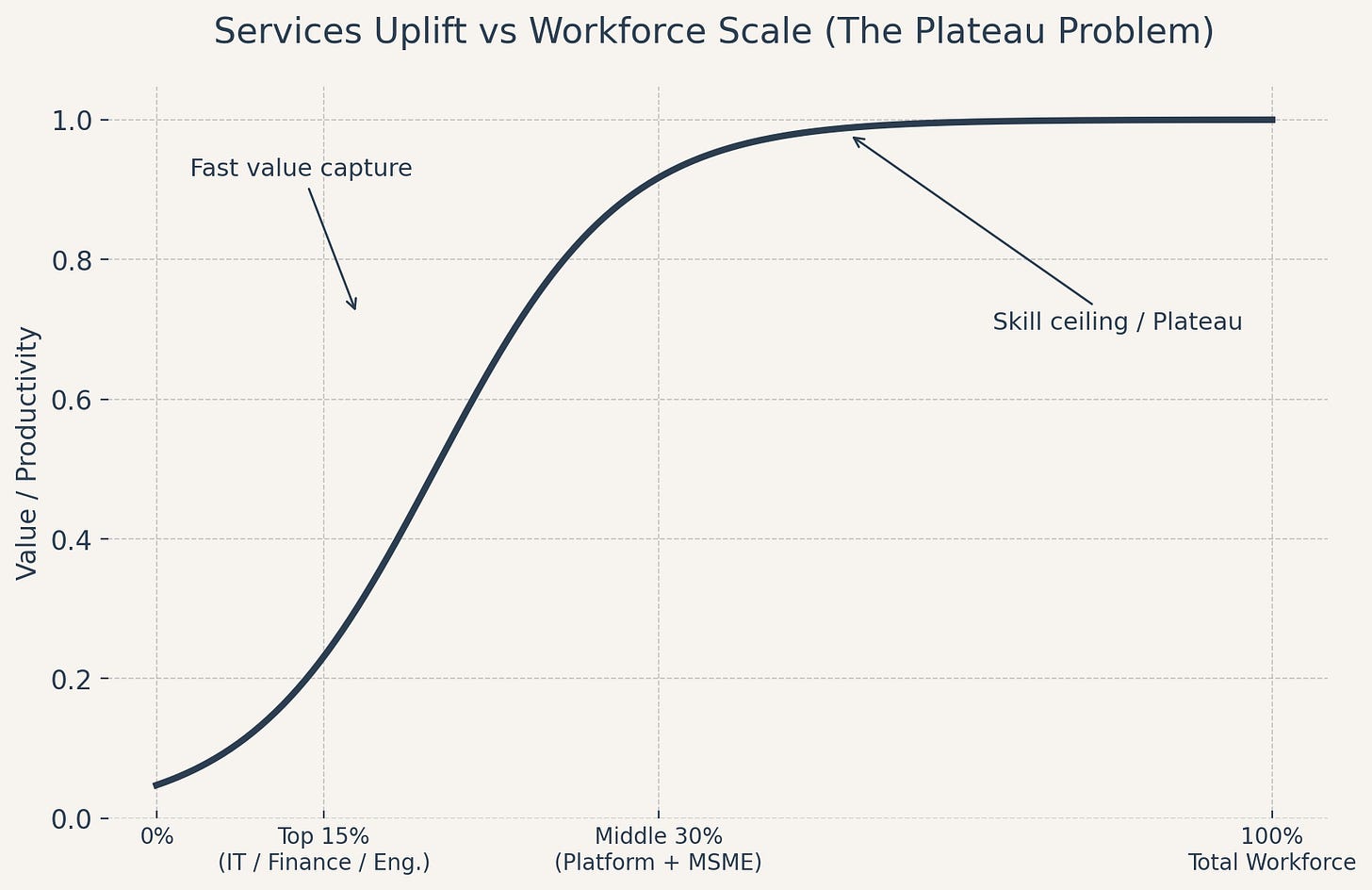
Services are skill intensive. Manufacturing can employ someone with 8 years of education. Services require 12-16 years minimum. India’s education system produces maybe 10 million college graduates annually. The working-age population is 900 million. What happens to the other 890 million?
Platform jobs are precarious. A Swiggy delivery rider earns ₹15,000-25,000/month ($180-300) with no benefits, no job security, physical risk, and no pension. A Chinese factory worker in 2010 earned similar amounts but with dormitory housing, meals provided, and a 30-40% savings rate that enabled upward mobility. The gig economy does not build the middle class. It offers subsistence work dressed up in apps.
Services don’t have manufacturing’s spillovers. When you make smartphones, you learn materials science, precision manufacturing, supply chain management, quality control. These skills transfer across industries. When you answer customer service calls or deliver food, you learn… customer service and delivery. The spillovers are much narrower. There’s no indigenous technological capability being built.
Services employment is geographically concentrated. Bangalore, Hyderabad, Gurgaon, Pune, and Chennai, perhaps 10–15 cities in total, account for more than 80 percent of quality service jobs. China’s manufacturing boom created employment across dozens of cities and hundreds of towns. India’s services boom has created regional inequality that’s becoming politically explosive. The Hindi heartland states (UP, Bihar, MP, Rajasthan) have barely benefited.
The scale mismatch is unsolvable. India’s IT sector directly employs roughly 5 million people. Include indirect employment (support services, real estate, transportation) and you get to maybe 15-20 million. China’s manufacturing sector employed over 100 million at its peak. The orders of magnitude are completely different.
This is what economists call “premature deindustrialization,” where India has the employment structure of a developed economy (services-heavy, manufacturing-light) without the income levels. Only 12% of India’s workforce is in manufacturing versus 25-30% at comparable stages in East Asia. India skipped straight from agriculture to services, and the result is a dual economy: islands of high-wage, high-skill prosperity surrounded by an ocean of low-productivity underemployment.
The honest assessment: Services create prosperity for the top 15% while leaving everyone else in informal sector limbo. This might be politically sustainable in a small country. At India’s scale, with 900 million working-age people, it’s a recipe for permanent mediocrity and growing inequality.
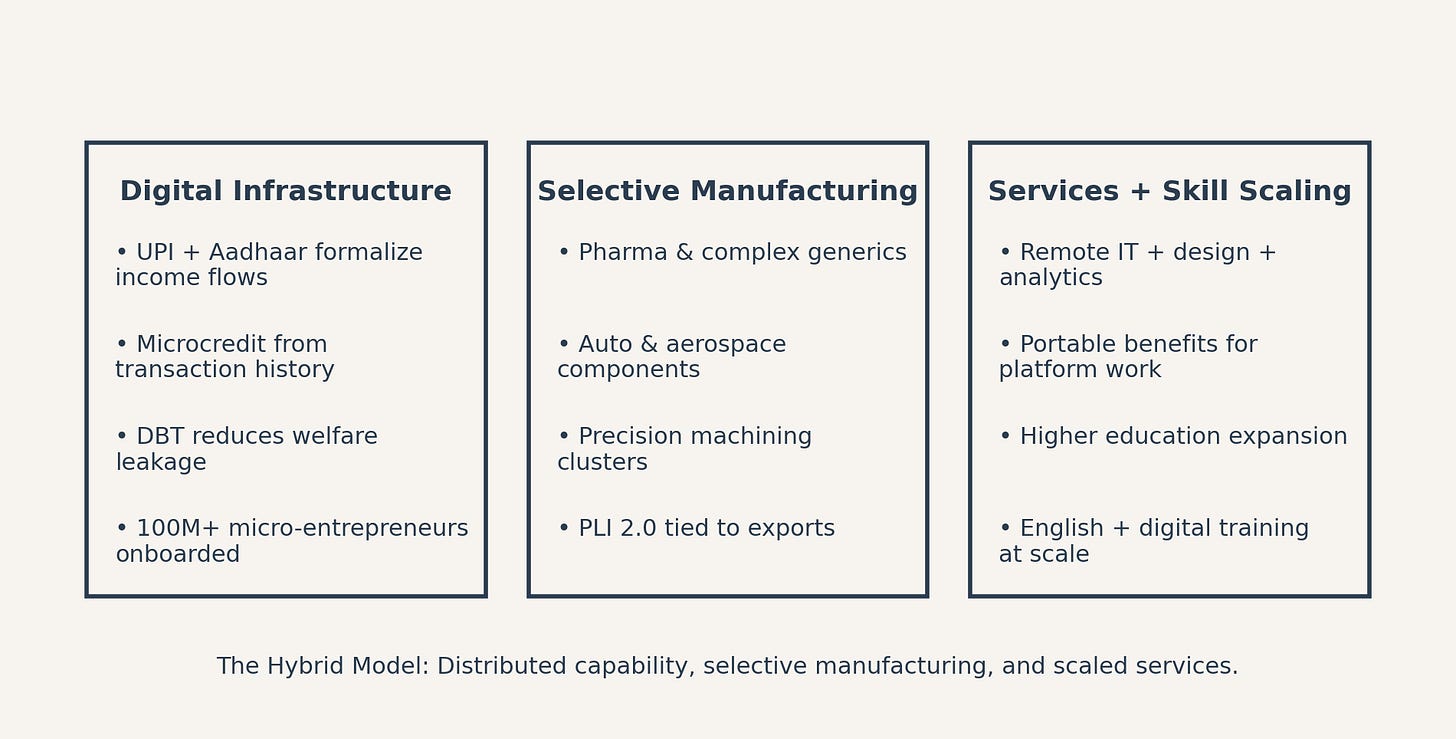
Even if the services path is insufficient, it might be all India has. The manufacturing path is foreclosed by democratic constraints, missed timing, and Chinese competition. The question isn’t whether services are sufficient (they’re clearly not). It’s whether a hybrid model combining services, digital infrastructure, and selective manufacturing can deliver broad-based prosperity at democratic scale.
Part VII: The PLI Gamble (Is India Finally Learning the Lesson?)
This brings us to the Production-Linked Incentive scheme, launched in 2020, which is either India’s belated attempt to do export discipline right or the License Raj with better marketing.
PLI offers subsidies to manufacturers based on incremental production and sales in strategic sectors: smartphones, semiconductors, solar panels, electric vehicles, pharmaceuticals. The government has committed over $30 billion across 14 sectors.
What’s Working
The results in electronics are real. At India’s scale, with 900 million working-age people, it’s a recipe for permanent mediocrity and growing inequality. Foxconn, Wistron, and Pegatron have built massive facilities employing 150,000+ workers. Electronics manufacturing grew 17% annually from 2019-2023 versus 7% previously. 4
This is genuine progress. For the first time, India has attracted global manufacturing at scale. The supply chain is developing, with component suppliers setting up operations, logistics infrastructure improving, and the ecosystem thickening.
Pharmaceuticals have seen similar success. India supplies 20% of global generic drugs and 40% of generic demand in America. Pharmaceutical exports grew from $20 billion to $27 billion from 2019-2024, with PLI accelerating growth in active pharmaceutical ingredients and complex generics.
What’s Not Working
But look closer and the problems emerge.
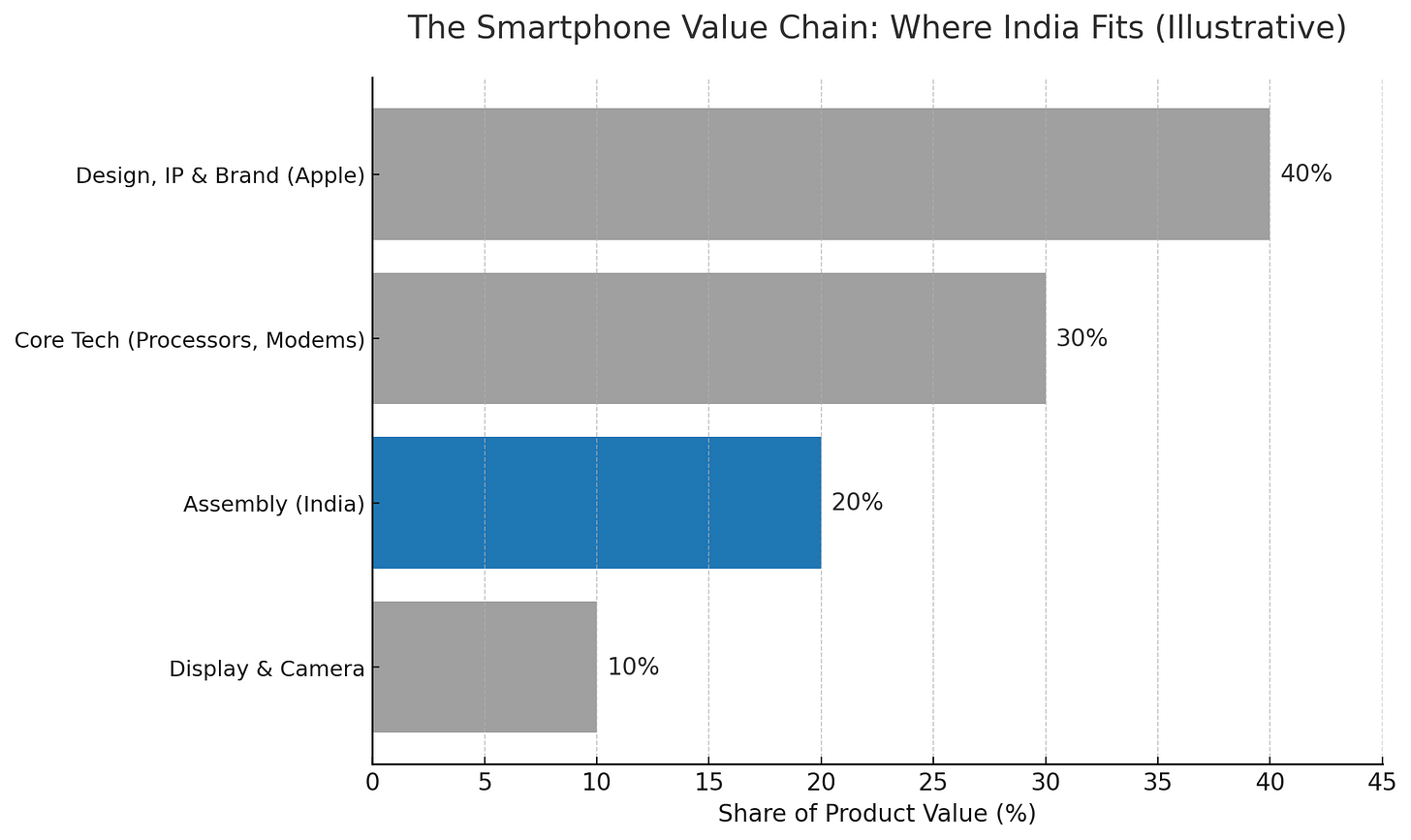
Value addition is minimal: Mobile phone manufacturing in India has roughly 20% domestic value addition versus China’s 49%. 5 The supply chain is developing, as component suppliers set up operations, logistics infrastructure improves, and the ecosystem thickens. This creates assembly jobs but not technological capability. When Foxconn builds iPhones in India, Apple still designs in California, chips come from Taiwan, displays from South Korea. India is a labor platform, not a technology hub.
No mandatory export requirements: This is the killer. PLI subsidies are linked to incremental production and sales, but firms can claim incentives while selling domestically. There’s no requirement to compete in global markets, no penalty for failing to export. A firm can optimize for capturing government subsidies rather than building global competitiveness. This is less export discipline and more subsidized import substitution with extra steps.
Semiconductor PLI has largely failed: This was supposed to be the crown jewel: the effort to build India’s semiconductor industry. The government offered $10 billion in incentives. The results? Intel, TSMC, and Samsung all passed. India secured only one small operation, Micron’s assembly and testing unit in Gujarat, not an advanced fabrication plant. The most strategic and capital-intensive sector flopped because India lacks the ecosystem, the skilled workforce, and the track record.
Political economy hasn’t changed: Firms still lobby for subsidies based on investment announcements and employment promises. Politicians celebrate factory inaugurations regardless of whether those factories produce anything competitive. The GP (the Indian state) still cannot cut losers, because those losers employ workers in politically important states. When a PLI firm underperforms, the response is not “cut them off,” it is “extend the timeline, increase the subsidy, renegotiate the terms.”
My Prediction (Falsifiable)
PLI will create assembly jobs but fail to build technological capability.
By 2030:
-
India will assemble 25-30% of iPhones (up from 15-20% today)
-
Electronics exports will reach $100-120 billion (up from ~$30 billion)
-
BUT value addition will remain ~25-30%, not the 50%+ that indicates real capability
-
India will NOT have a globally competitive indigenous smartphone brand with domestically designed chips
-
Semiconductor manufacturing will remain minimal—assembly and testing only, no advanced fabs
The test that matters: In 2030, does India have a smartphone brand that it designs and manufactures, selling globally with 3-5% market share outside India? Not assembling Apple’s phones—designing its own.
South Korea had Samsung. China has Xiaomi, Oppo, Vivo, and Huawei. These are not just assemblers; they design their own phones, increasingly design their own chips, and compete globally on technology and price. If India has one of these by 2030, PLI worked. If India is still just assembling other companies’ products, then PLI was the License Raj in new clothes.
Why am I pessimistic? Because Indian democracy still can’t impose the brutal discipline that made Samsung and Hyundai succeed. The GP faces elections every five years. Politicians get rewarded for visible outcomes: factory inaugurations, job announcements, investment commitments. They don’t get rewarded for invisible outcomes that take 15-20 years: learning curves, indigenous innovation, technology absorption.
This is actually a conservative estimate. The current trajectory suggests 35 to 40 percent by 2030, but I expect geopolitical constraints or quality issues to limit growth. Until India adds mandatory, rising export requirements with consequences for missing them, and until a firm can lose PLI support for failing to compete globally, this remains subsidy allocation with performance metrics. That is better than the License Raj, but it is not export discipline.
Part VIII: What Indian Success Actually Looks Like
So, what does success look like for India in 2040, given all these constraints?
Not this: India becomes a manufacturing superpower that out-competes China. That window closed. China has a 20-year head start, authoritarian discipline to force restructuring, and $2 trillion in installed manufacturing capacity.
Not this: India becomes a pure services economy like Singapore. Singapore is 5 million people in a city-state. That model doesn’t scale to 1.5 billion people in a subcontinent.
This: India pioneers a hybrid model that leverages its structural advantages, including digital infrastructure, democratic stability, and English-speaking talent, while selectively building manufacturing capability in domains where it can actually compete.
The Three-Pillar Model
Pillar One: Digital Infrastructure as Foundation
India’s JAM stack plus UPI is genuinely world-class. This creates possibilities that Northeast Asia didn’t have:
Formalization of the informal economy: 85 percent of India’s workforce is informal: street vendors, construction workers, agricultural laborers, and domestic workers. They are outside the tax system, outside formal banking, and largely invisible to government support. Digital infrastructure changes this.
Here’s what it looks like in practice: A street vendor in Mumbai selling vada pav has a UPI QR code. She processes 50 transactions daily, ₹200 average. That’s ₹10,000 monthly revenue, digitally recorded. After six months, she has transaction history. A fintech lender offers her ₹30,000 working capital at 18% interest to buy a better cart and expand inventory.
She doesn’t need collateral. She doesn’t need to bribe a bank officer. The loan is approved algorithmically based on her transaction history. She repays over 12 months through automatic deduction from daily UPI receipts.
This is formalization without factories. Scale this to 100 million micro-entrepreneurs and you’ve brought a third of the informal economy into the formal economy without building a single manufacturing plant.
Does this work at scale? Too early to tell, but early results are promising. Over 500 million Indians have Jan Dhan bank accounts. UPI processes 10+ billion transactions monthly. Fintech lenders disbursed over $50 billion in microloans in 2023, using digital transaction history to serve borrowers the formal banking system would never reach. 6
Direct benefit transfers eliminate intermediaries: India now transfers over $200 billion annually directly to beneficiaries via JAM-DBT, including food subsidies, cooking gas subsidies, and rural employment wages. This eliminates the corrupt middlemen who used to skim 20-30% of welfare spending. If you can run a welfare state without an industrial tax base by using digital infrastructure to reduce leakage, that’s genuinely new.
Pillar Two: Selective Manufacturing
Not “make everything” but “make what we’re actually good at”:
Pharmaceuticals: India already supplies 20% of global generics. This works because it’s high-mix, low-volume production where Indian firms have genuine capability built over 40 years. This isn’t assembly; Indian firms actually develop generic formulations, manufacture active ingredients, and handle complex chemistry. Continue building here.
Specialized components: Auto parts (India exports $20+ billion annually), aerospace components, precision machinery. These are niches where scale isn’t everything. Indian engineers plus relatively low labor costs create advantages that mass manufacturing doesn’t have.
High-mix, low-volume manufacturing: Custom industrial equipment, specialized machinery, small-batch production. The opposite of Chinese mass manufacturing. India won’t make a billion smartphones, but it might make 10,000 specialized industrial robots annually.
The requirements for this to work:
-
Actual export requirements in PLI 2.0 (mandatory targets with consequences)
-
Technology partnerships with real IP transfer, not just FDI for assembly
-
Patient capital willing to fund 10-15 year buildouts
-
Most importantly: willingness to cut losers, which democracy makes nearly impossible
Pillar Three: Services Scaling
The question isn’t whether services create wealth. They obviously do. It’s whether they can create mass employment.
The path that might work:
-
Platform economy matures from pure gig work to stable employment with portable benefits linked to Aadhaar
-
Remote services expand beyond IT to design, analytics, legal services, medical diagnostics, content creation, education
-
Digital infrastructure enables micro-entrepreneurship at massive scale: 50-100 million people running small service businesses with digital tools
-
Education system expands dramatically: 500+ world-class universities producing 20-30 million graduates annually
The requirements (politically brutal):
-
10x increase in higher education spending sustained over 20 years to build 500+ quality universities (India has maybe 30-40 today)
-
Labor law reform to make formal sector employment viable (currently firms avoid formal hiring because they can’t fire anyone)
-
Social safety net: universal basic healthcare, unemployment insurance, portable pensions (requires tax base India doesn’t have)
-
English education reaching 500+ million people (currently ~125 million speak working English)
This is a 25-30 year project with no guarantee of success.
What This Delivers
If the hybrid model works, and that is a big if, India reaches $7,000–8,000 GDP per capita by 2040, not the $10,000+ that might be possible with full manufacturing success. That’s 500+ million people lifted from poverty to lower-middle-class status. Regional inequality persists but doesn’t explode into political crisis. Services employ 50-60 million in quality jobs. Manufacturing provides another 50-60 million in niches where India has comparative advantage. The informal economy shrinks from 85% to 70% of employment. Digital infrastructure enables a welfare state that prevents the bottom from falling out entirely.
This isn’t spectacular. It’s not the East Asian miracle. But at India’s scale, lifting half a billion people from $2,500 to $7,000+ per capita while maintaining democracy, religious pluralism, and relative stability would be historically significant. It would prove that democratic development at scale is possible, just slower and messier than authoritarian development.
Part IX: The Question We’re Avoiding
Here’s the uncomfortable question underlying this entire essay:
Was democracy worth it?
Consider two counterfactuals:
Counterfactual One: Authoritarian India
-
Military coup in 1960, authoritarian regime through 2000
-
Executes Studwell playbook: brutal land reform, export discipline, financial repression
-
GDP per capita reaches $12,000-15,000 by 2024 (similar to China)
-
500+ million people lifted from poverty faster
-
But: political repression, no free speech, periodic mass violence, possible famine if policies fail (like China’s Great Leap Forward)
Counterfactual Two: Actual Democratic India
-
Democracy maintained throughout
-
GDP per capita $2,500 by 2024
-
Slower poverty reduction, but no catastrophic policy failures
-
Free press, regular elections, religious and linguistic diversity protected
-
Peaceful reform possible (1991 liberalization happened without revolution)
Which is better?
Most Indians and I imagine most readers, would choose democracy. But we should be honest about the economic cost. My estimate: probably $8-12 trillion in cumulative foregone GDP over 70 years, and 300-400 million people who remained in poverty 20-30 years longer than necessary.
How confident should we be in this number? Not very. The counterfactual assumes authoritarian India would have executed the playbook successfully, but look at authoritarian failures: Myanmar, Pakistan under military rule, most of sub-Saharan Africa’s dictatorships. Authoritarianism enables good policy but doesn’t guarantee it. Maybe authoritarian India would have been more like Pakistan (military coups, fragmentation) than South Korea.
The honest answer: we don’t know what authoritarian India would have looked like. But we know what democratic India actually did, and it was slower than East Asian authoritarianism. That’s the comparison we can make.
That’s the price. Now, many things are worth economic sacrifice. Political freedom matters. Avoiding mass death from policy errors matters. The ability to course-correct peacefully matters. Religious and linguistic pluralism matters, especially in a country as diverse as India.
The normative claim “democracy is worth it” doesn’t require denying the economic cost. It requires arguing that some values justify economic sacrifice. I believe they do. But I want the argument to be honest about what was sacrificed.
And I want development economics to be honest about what its favored model requires. For 50 years, the field has implicitly treated the East Asian model as universal best practice while tiptoeing around the fact that it required authoritarian state capacity that most countries don’t have and arguably shouldn’t want.
Part X: The Test
Here’s how we’ll know if India’s hybrid model works. These are falsifiable predictions:
By 2030 (The First Exam)
Manufacturing capability test: Does India have a smartphone brand with 3-5% global market share (excluding India) that designs its own phones and uses indigenously designed chips for at least some components?
-
Current status: No. Indian brands (Micromax, Lava) collapsed.
-
My prediction: Still no. PLI creates assembly, not design capability.
Value addition test: Does India achieve 40%+ domestic value addition in electronics manufacturing (currently ~20%)?
- My prediction: Reaches 25-30% but not 40%. Meaningful progress but still mostly assembly.
Services scaling test: Do tradeable services directly employ 50+ million people earning above India’s median wage (currently 15-20 million)?
- My prediction: Possible if remote services and platform economy expand aggressively. This one might succeed.
By 2040 (The Final Exam)
GDP per capita test: Does India exceed $9,000 per capita (2024 dollars)?
-
Current status: $3,000
-
Required growth: ~8% annually for 15 years
-
My prediction: India reaches $9,000-10,000. Meaningful progress, but below optimistic scenarios.
Employment structure test: Has formal sector employment exceeded 40% of workforce (currently ~15%)?
- My prediction: Reaches 25-30%. Digital infrastructure helps but not transformative.
Inequality test: Has regional income inequality (ratio of richest to poorest state) narrowed or widened?
-
Current status: Widening (Karnataka at ~$3,500 per capita vs Bihar at ~$800)
-
My prediction: Continues widening. Services concentration in 10-15 cities makes this worse.
The definitive test: Does an Indian company (not assembling for a foreign brand) sell a high-tech manufactured product globally with significant market share?
- My prediction: Happens in pharmaceuticals, maybe in specialized manufacturing. Does not happen in electronics, semiconductors, or mass manufacturing. Though I believe a few definitive consumer brands will come out of India during this period.
Conclusion: The Pitch Deck We Can’t Fund
The Northeast Asia Developmental Capital fund generated spectacular returns because it had ruthless general partners with decades-long time horizons, captive limited partners who couldn’t redeem, an Investment Committee evaluating firms purely on export performance, an external sponsor providing patient capital and guaranteed market access, and the political capacity to impose enormous short-term costs for long-term gain.
India is trying to generate returns with a general partner facing elections every five years, activist limited partners who can fire the GP, multiple competing GPs with veto power over reforms, no external sponsor, and democratic constraints that make it nearly impossible to impose short-term costs even for massive long-term gain.
The question was never “Can India copy the playbook?” The playbook requires authoritarian state capacity that large democracies structurally lack.
The real question is whether a large democracy can pioneer a path to prosperity designed for its democratic constraints rather than in spite of them.
My answer: conditionally yes, but with lower returns than the authoritarian model.
If India accepts it can’t do mass manufacturing, scales services through massive education investment, uses digital public infrastructure to formalize the informal sector, builds a social safety net enabling entrepreneurship and labor mobility, and accepts slower growth (7–8% for 20 years rather than 10%+ for three decades), then India might reach $7,000–8,000 per capita by 2040–45.
Not the $30,000+ that authoritarian East Asia achieved, but enough to lift half a billion people into lower-middle-class prosperity while maintaining democracy. That would prove democratic development at scale is possible, just slower. It would provide a model for Brazil, Indonesia, Nigeria, Bangladesh, Mexico. It would show that the “development as authoritarianism” pathway isn’t the only one, just the faster one.
The test is running. I’ve given you my predictions. They’re falsifiable. Check back in 2030.
My bet: India will assemble iPhones but won’t design them. Services will employ millions but not enough. The hybrid model will deliver partial success, meaning meaningful poverty reduction, some manufacturing capability, significant services growth, but persistent informality and regional inequality.
That’s not the pitch deck that gets funded. But it might be the only pitch deck that survives democratic accountability.
And if I’m wrong, if India has an indigenous smartphone brand competing globally in 2030, if services have scaled to mass employment, if the hybrid model delivers $10,000 per capita by 2040, then I will have dramatically underestimated what democracy can achieve when it stops trying to copy authoritarian playbooks and writes its own.
I’d be thrilled to be wrong. But I don’t think I will be.
Footnotes
-
Studwell, How Asia Works, pp. 56-68. All subsequent Taiwan agricultural productivity figures from this source unless otherwise noted. ↩
-
Justin Yifu Lin, “Rural Reforms and Agricultural Growth in China,” American Economic Review 82, no. 1 (1992): 34-51. ↩
-
John Giles, Albert Park, and Juwei Zhang, “What is China’s True Unemployment Rate?” China Economic Review 16, no. 2 (2005): 149-170. ↩
-
India Cellular and Electronics Association, annual reports 2019-2024. ↩
-
Counterpoint Research, “India Smartphone Market Analysis” (2023). ↩
-
Reserve Bank of India, “Report on Trend and Progress of Banking in India” (2023). ↩