India's Pesky Little Problem of Expensive Money
Everything is Expensive, Especially Money
There is an invisible tax on everything India wants to become. It’s a tax on building factories, on funding startups, on paving roads, and on creating jobs. It doesn’t show up on any government form, but every corporate treasurer, every project finance banker, and every venture capitalist in the country pays it every single day. This tax is the high cost of capital.
Look, the story is simple: India has a billion-plus people ready to work and consume. It’s the demographic dividend, baby! But a dividend is a return on capital. If the capital itself is prohibitively expensive, you don’t get much of a dividend. You just get a lot of expensive debt and demanding shareholders.
In the world of corporate finance, the price a company pays for its money is called the Weighted Average Cost of Capital, or WACC¹. It’s the blended price of the money you get from shareholders (equity) and the money you get from lenders (debt). It’s the hurdle rate for any new project. If your shiny new factory can’t earn a return higher than your WACC¹, you are actively making your owners poorer. You are burning value.
The problem is that in India, this hurdle is set very, very high.
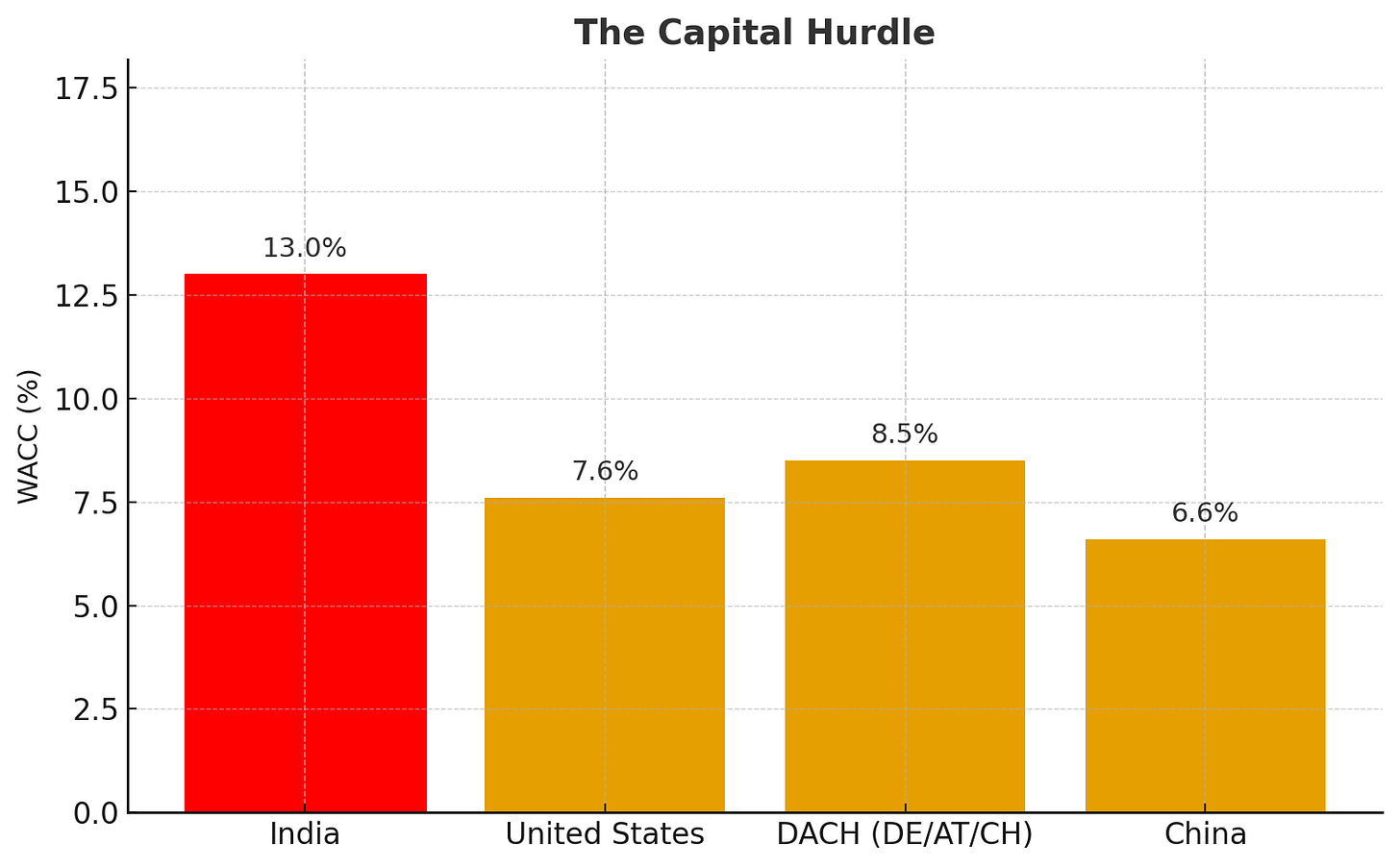
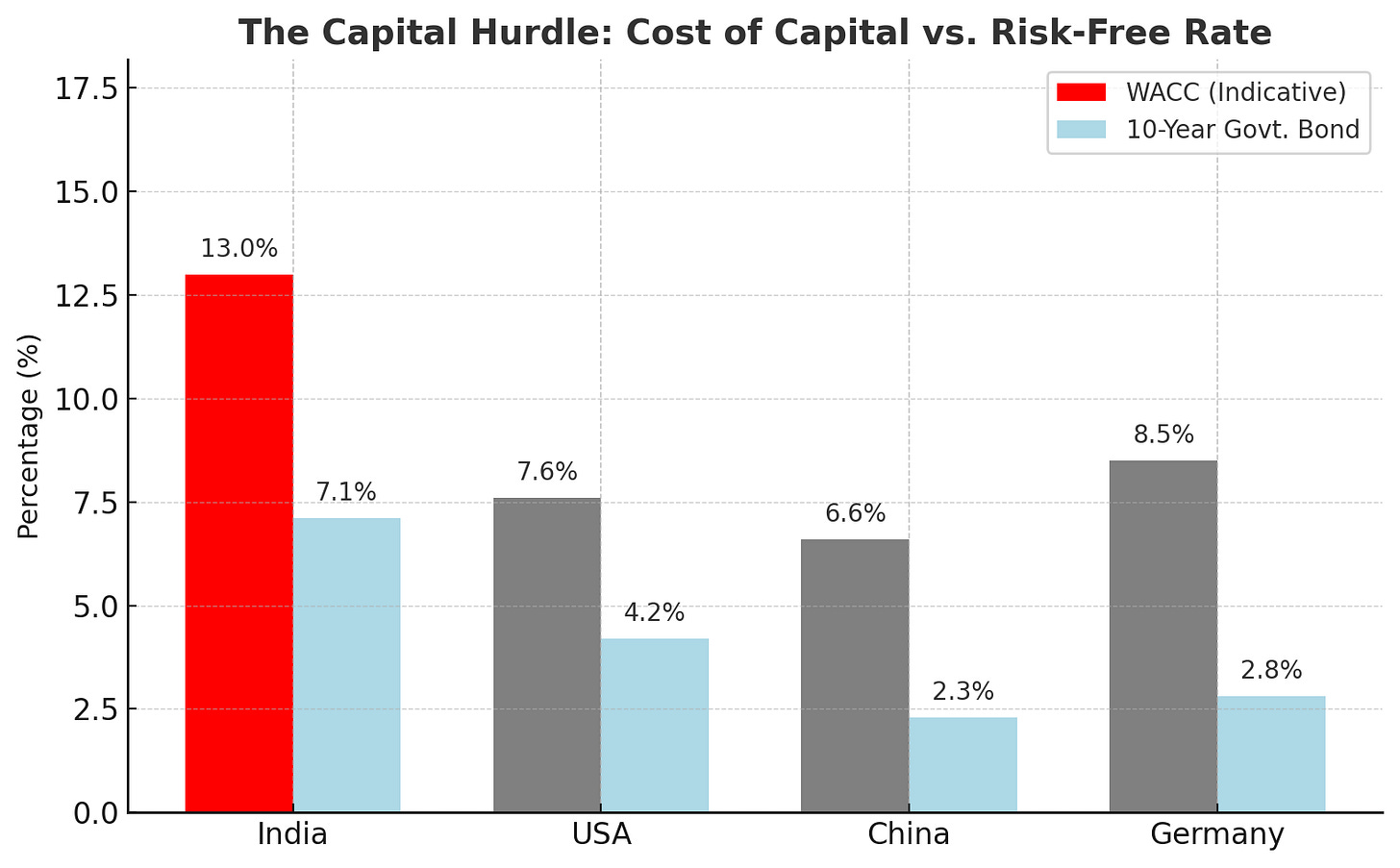
Depending on which analyst you ask, the WACC¹ for a typical Indian company is somewhere in the double digits, often 11% to 15%. In the U.S., it’s more like 7.6%. In China, it’s maybe 6.6%. This is not a small difference. It means a perfectly good project that would get a green light in Ohio or Guangzhou is dead on arrival in Gujarat. Capital is a global commodity, but it clearly doesn’t have one global price.
So, this post is a two-parter. First, the diagnosis: why is everything so expensive? We’ll look at both equity and debt. Second, the prescription: a set of concrete, plumbing-focused ideas to fix it. Let’s go.
Why Is Everything So Expensive?
To understand India’s high WACC¹, you have to break it into its two main ingredients: what shareholders demand (cost of equity) and what lenders charge (cost of debt). Both are expensive, but for fascinatingly different, and deeply interconnected, reasons.
The Price of Ownership (Cost of Equity)
The cost of equity is the return investors demand for the risk of owning your stock instead of, you know, a boring government bond. The textbook way to calculate this is the Capital Asset Pricing Model, or CAPM, which won a Nobel Prize and is taken very seriously despite everyone knowing it’s sort of a useful fiction.
Basically, it says your expected return should be the “risk-free” rate plus a bonus for taking on market risk. In India, every part of this formula is inflated.
-
The Not-So-Risk-Free Rate: The floor for all investment returns is the yield on long-term government bonds. In India, this floor is on a higher floor. The 10-year bond yield is consistently around 7%. The U.S. equivalent is ~4.2%. Why? Well, inflation is part of it. But the bigger, more structural reason is that the Indian government is an absolutely massive borrower. It runs a big fiscal deficit and plugs the gap by issuing a constant, torrential flood of bonds. This is a classic “crowding out” effect. The government is drinking everyone else’s milkshake. To get investors to absorb all this paper, it has to offer a high yield. This high yield then becomes the baseline for everything. The government’s borrowing habit acts as a hidden tax on all private enterprise.
-
The ‘India Premium’: On top of that high floor, investors demand an extra reward for the unique weirdness of investing in an emerging market. This is the Equity Risk Premium, and it includes a “Country Risk Premium.” This is the price of uncertainty. It’s compensation for things like the rupee deciding to take a nosedive, or a sudden, surprising policy change. Valuation guru Aswath Damodaran estimates India’s country risk premium at around 7.5% above the base equity premium, derived from its sovereign credit rating and market volatility. Global investors have long memories. They remember past currency crises and bouts of high inflation. It takes decades of boring stability to erase those memories from the risk models. A well-run Indian company today is still paying for the policy sins of the past.
-
The “Are These Numbers Real?” Premium: And then there’s the fun one. There is an unstated premium baked into India’s cost of equity that accounts for, let’s say, creative accounting. A history of spectacular corporate governance failures means savvy investors implicitly price in the risk that the profits on paper might not quite match the cash in the bank.

The ghosts of Satyam (“India’s Enron”), IL&FS, Kingfisher Airlines, and others haunt the market. These events create a trust deficit. Good governance lowers the cost of capital because investors worry less that you’re going to divert company money to, say, buy a yacht. When governance is weak, this risk spikes during a recession, right when investors are most scared. That makes your stock fundamentally riskier, so investors demand a higher return all the time as compensation.
The Price of Borrowing (Cost of Debt)
If equity is about pricing fear, debt should be simple. It’s a contract. But in India, the cost of debt is kept high by a government that dominates the borrowing market, a corporate bond market that’s more of a private club than a public utility, and a banking system with some serious institutional PTSD.
-
The 800-Pound Gorilla is Still the Government: I know, we talked about this. But it’s even more important here. The government soaks up so much of the country’s savings that it starves the corporate bond market of oxygen. Insurance companies and pension funds—the natural buyers of long-term corporate debt—are required to hold tons of government securities. Why bother analyzing a private company’s 10-year bond when you can get a juicy 7% from the government with zero effort?
-
The Bond Market That Isn’t: The direct result is an anemic corporate bond market. In the U.S., the corporate bond market is over 100% of GDP. In India, it’s a measly ~18%. And it’s not really a public market. Over 95% of issuance is through private placements. It’s a club for top-rated financial firms and state-owned enterprises. For most Indian companies, the bond market might as well be on the moon. Their only option is to go, cap in hand, to a bank.
-
The Banker’s Hangover: For much of the last decade, Indian banking was defined by Non-Performing Assets (NPAs). A mountain of bad loans, which peaked at a staggering 11.2% in 2018, almost broke the system. A painful cleanup has brought that number way down, but the experience left deep scars. Banks are now deeply risk averse. Faced with a choice between a complex 15-year loan to a power plant (which caused the last crisis) and a simple 5-year car loan to a salaried professional, the banker makes the easy choice. This starves the industrial economy of the long-term capital it needs.

The Prescription: It’s The Boring Stuff That Matters
There is no magic wand. The solutions require patient, unglamorous work on the plumbing of India’s financial markets.
-
Build a Bond Market People Actually Use. We don’t need another report. We need action.
-
Pay people to trade. Create real incentives for market-makers to provide continuous buy and sell quotes. If people know they can always sell a bond, they’ll pay more for it (which means a lower yield).
-
Stop making so many bonds! Mandate that big company’s re-issue their existing bonds instead of creating a new one every time. This creates a smaller number of large, liquid bonds that can actually be traded.
-
Help the little guy. A government-backed fund that provides partial guarantees for bonds from solid, but not AAA-rated, companies would open the market to a huge new slice of the economy.
-
-
Make Bankruptcy Scary Again. The Insolvency and Bankruptcy Code (IBC) was supposed to be a game-changer. The fear of losing your company is a powerful motivator to pay your debts. But the process has gotten bogged down.
-
The Timeline: It’s supposed to take 270 days. The average is now 683 days.
-
The Recovery: Lenders get back only about 32 paisa on the rupee.
-
The Fix: Hire more judges. Triple the capacity of the bankruptcy courts (NCLT). Promote pre-packaged insolvencies (PPIRP). Make the process swift and predictable so the threat is real again.
-
-
The Government Needs to Borrow Less. This is the big one. There is no policy lever more powerful for lowering the cost of capital than fiscal discipline. If the government borrows less, the “risk-free” rate falls, the crowding-out effect diminishes, and the bond market has room to breathe. Everything gets cheaper.

It’s the boring stuff that matters. Lowering the cost of capital is about building a liquid bond market, ensuring the bankruptcy code works, and enforcing corporate governance so investors can trust the numbers. And most of all, it’s about the government maintaining fiscal discipline until the world’s perception of India’s riskiness aligns with its reality.
Each step is incremental. But together, they build the one commodity that is most essential for cheap capital: trust. In finance, trust is just another word for a lower interest rate. And for an economy with India’s ambitions, there is no more valuable asset.
¹ The WACC formula is:
You don’t really need to know this, but this is what the finance people look at. The CAPM one is:
where CRP is the Country Risk Premium. The joke is that Rₘ - Rƒ, the Equity Risk Premium, is basically just a number of people argue about. It’s a guess, but a very important guess.